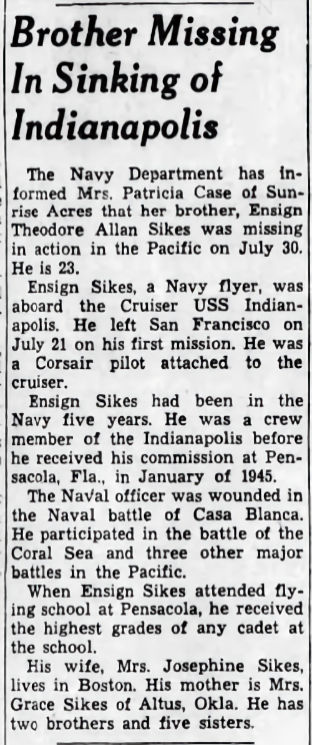
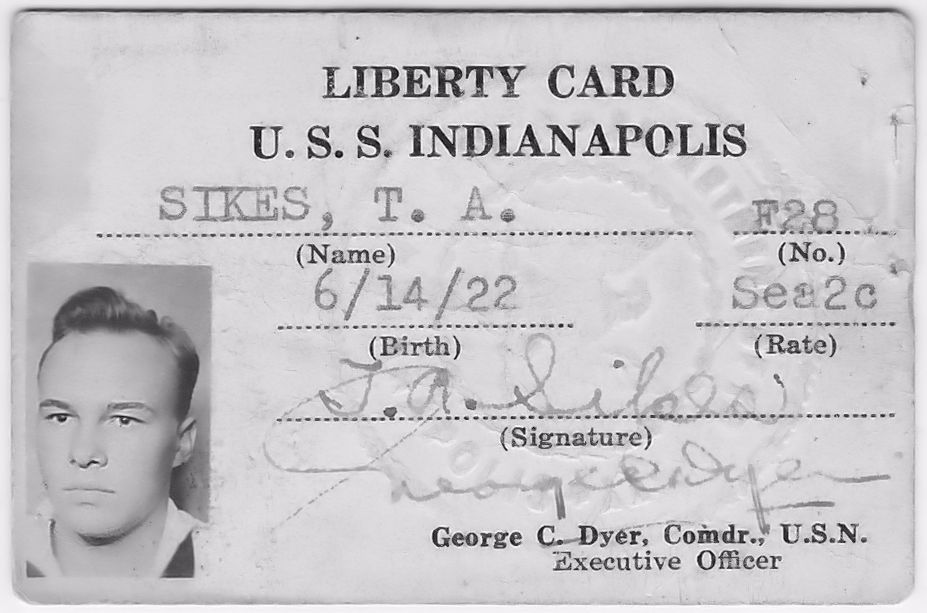
Rank / Rating: ENS-Ensign
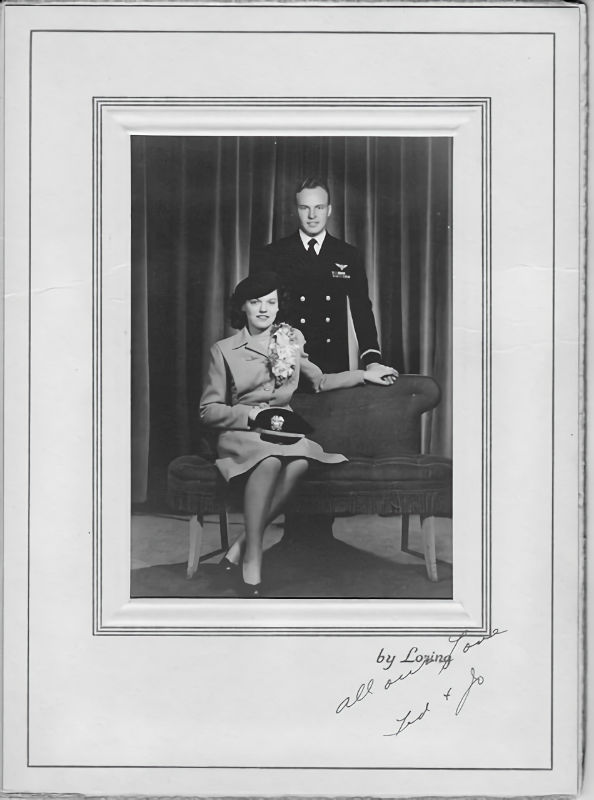 Ted was the youngest of eight children born to William Henry and Grace Irene Pursley Sikes. His father was 64 years old when Ted was born and his mother was 38.
His siblings were Henry A., John W., Martha V. (Raymond), Irene Patricia (Case), Elizabeth D. C. (Renfro), Juanita H. (Amberster) and Ruby Opal Sikes.
According to the 1940 US Colorado Census, Ted was born in New Mexico and lived with his mother and brother at 814 Tillotson Street, Trinidad, Los Animas Co., CO. This census was enumerated Apr 12, 1940 and notes his age as 17 years and had completed 3 years of high school. This listing followed the rules of the census in recording the age at last birthday and highest grade of high school completed at the time of the census. Ted had completed the 11th grade, but was now a senior in high school.
Ted graduated from Trinidad High School on May 29, 1940. His senior yearbook shows he was very athletic. He played football, ran track and cross country as well as intramural sports. In his early years of school he was a member of the band and orchestra. Also, he completed a college preparatory class.
Four months after graduation, he entered the USN. He was 18 years old.
After completing basic training in San Diego, CA, Ted was assigned to USS Indianapolis. The ship was in Pearl Harbor so Ted traveled almost 3,400 nautical miles of the Pacific Ocean on board USS Dewey DD-349 to Pearl Harbor. After a nine day journey he arrived and went aboard Indianapolis the following day, Oct 11, 1940. He went on board as a Apprentice Seaman (AS) but quickly advanced to the rate of S2/c on Dec 6, 1940. On May 1,1941 his rate advanced to S1/c.
Ted’s father, William Henry Sikes, passed away in a hospital in Charlottesville City, Albemarle Co., VA, on Jan 19, 1941, at age 82, while Ted was serving on board Indianapolis. Mr. Sikes was a resident of Waynesboro, Augusta Co., VA and most likely living with his oldest son, Henry A. Sikes, Ted's brother.
Ted remained on board Indianapolis for ten months until August 1941 when he was transferred to attend Elementary Fire Control School, San Diego, CA. The ship was at Pearl Harbor when Ted left her so he embarked on another long voyage that began on August 2, 1941 on board USS Sabine AO-25. Upon arrival he made his way to training school at San Diego on Aug 15, 1941.
By Dec 8, 1941, he had completed Fire Control School. He reversed his voyage on board USS Harris AP-8 in San Diego for transfer back to Indianapolis, still stationed in Pearl Harbor. Harris arrived at Pearl Harbor on Christmas Eve, Dec 24, 1941. He reported aboard Indianapolis on Dec 27, 1941.
Ted’s Fire Control training would continue while back on board Indianapolis. After schooling and two long voyages, Ted’s mission was fulfilled when his rating was advanced on Feb 1, 1942 to FC3/c(M) - Fire Control 3rd Class. Fire controlmen were highly skilled technicians responsible for the operation of various forms of range finding gear as well as the solving of ballistics calculations to control the firing of the ship's guns. Also, they inspected, maintained and repaired fire control instruments, operated rangefinders and optical fire control equipment and repaired electrical firing circuits. Ted was now qualified to man fire control stations in action. Fire controlmen 1st, 2nd and 3rd class were divided into FC(M) (maintenance) and FC(R) (repair).
He would very shortly put his new skills to use.
“Her [Indianapolis] first action came in the South Pacific deep in enemy-dominated waters about 350 miles south of Rabaul, New Britain. Late in the afternoon of 20 February 1942, the American ships [Task Force 11] were attacked by 18 twin-engined bombers, flying in two waves. In the battle that followed, 16 of the planes were shot down by accurate antiaircraft fire of the ships and fighter planes from Lexington (CV-2). All ships escaped damage and they splashed two trailing Japanese seaplanes.” [DANFS]
Ted remained on board Indianapolis at Pearl Harbor until late March 1942 when he was transferred, but not before his ship again saw enemy action.
“On 10 March 1942 the Task Force, reinforced by carrier USS Yorktown (CV-5) attacked enemy ports at Lae and Salamaua, New Guinea, where the enemy was marshaling amphibious forces. Carrier-based planes achieved complete surprise by flying in from the south, crossing the high Owen Stanley mountain range, and swooping in to strike Japanese harbor shipping. As they inflicted heavy damage on Japanese warships and transports, the American flyers knocked down many of the enemy planes which rose to protect the ports. American losses were exceptionally light.” [DANFS]
His new assignment would be on USS Massachusetts BB-59, newly launched on Sept 23, 1941 at Quincy, MA. She was to be delivered to Boston Navy Yard in Apr 1942 and commissioned May 1942.
Indianapolis was returning to the US and Ted is listed as a passenger on his own ship. When he arrived in the US he was transferred off Indianapolis Apr 8, 1942 for the receiving station in San Francisco, CA. He arrived in Boston, MA Apr 14, 1942 and from there was transferred to Massachusetts where he went aboard May 12, 1942, just in time for her commissioning ceremony. He became a Plankowner of the ship, meaning he was on board at commissioning.
In six short months, Ted would find himself back in combat. Massachusetts’ first battle action was on Nov 8, 1942 during the invasion of North Africa as part of the USN's "Operation Torch." Off the city of Casablanca, Morocco, the ship engaged in a battle with a French battleship. She fired the first 16" projectile of WWII, in battle conditions. Four more projectiles resulted in the sinking of the foreign enemy battleship.
Ted wrote a letter home to his mother describing the events of this day, as well as previous events. It was published in the Coalgate, Oklahoma Record Register newspaper on Dec 31, 1942 and titled, “News from The Boys in Service.”
“I went to Casablanca in West Africa. We kicked hell out of things Nov 8. As you probably read, I got a scratch on the right leg. It put me out for a few days, but I soon got over it with no remaining damage. Just a six inch scar.
Boy when this is over I will always be able to say I did my part. Gee, I have more bars than the Admiral himself, -almost-. Three battles in the South Pacific and one here gives me six bars and five medals We won't get the medals until after the war, so by then I may have a chest full. In the last battle, we were hit three times, damage slight, casualties few. My battle station was struck by fragments from a close miss. They did very little damage but the concussion from the burst checked most of us. I was knocked to my knees, others had broken ankles, and some had lumps on their heads from bouncing off the overhead. We shorter men got by pretty easy.”
Ted remained on Massachusetts until Dec 10, 1942 when he was transferred to aircraft carrier, USS Independence CV-22 where he arrived for duty on Jan 15, 1943, just one day after the ship was commissioned. For a second time he became a Plankowner of a new ship.
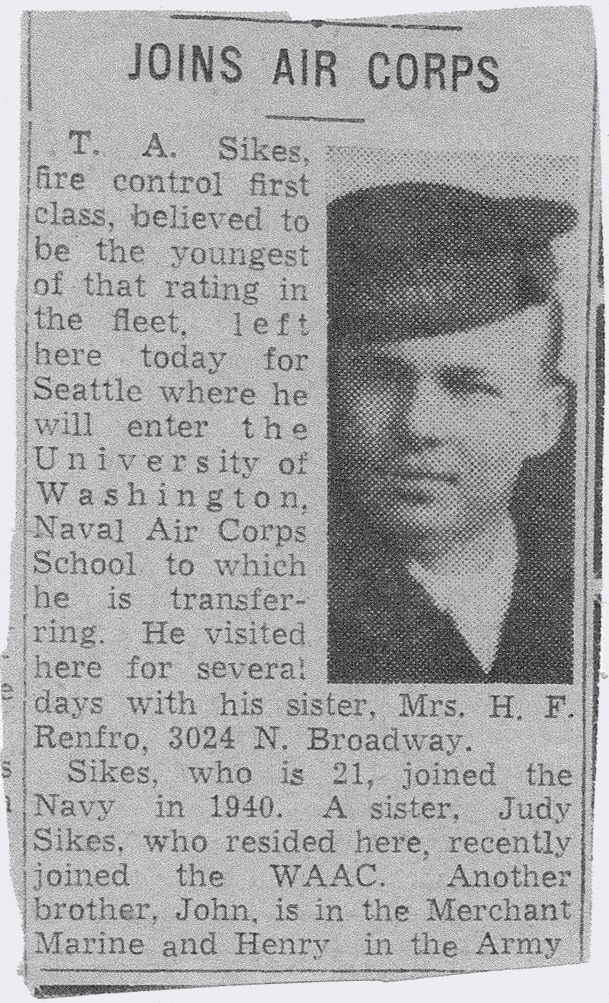
Perhaps it was his experience on this aircraft carrier that fueled his desire to become a pilot. He remained on Independence until Apr 8, 1943 when he agreed to extend his enlistment for 2 years. The same day he transferred to Receiving Station, Norfolk, VA for forwarding to the Naval Aviation Cadet Selection Board (NACSB), University of Washington, Seattle where he was received May 3, 1943.
Report of Changes for NACSB shows on Jun 4, 1943 he was “discharged” from the USN by "Special Order Disc". On June 5, 1943 he is noted as “received for enlistment", Seattle, WA as Aviation Cadet (AVCad), V-5, and two days later was transferred to NFPS, Murray State Teachers College, Murray, KY, a Navy Pre-flight School. This school was classroom teaching only and Ted completed the program in late August.
On Sept 3, 1943 he was received back at Seattle. A pre-flight school had opened recently at St. Mary’s College of California and on Nov 17, 1943 Ted was transferred there for additional training.
Three months later, on Feb 23, 1944, Ted was received at Naval Air Station, Norman OK, for Primary Flight Training. The official Navy log shows him listed as V-5 USNR, not USN. When Ted re-enlisted his commission changed from USN to USNR as was the regulation for all V-5 aviation cadets at the time. In all records going forward, he was noted as USNR with an enlistment date Jun 5, 1943.
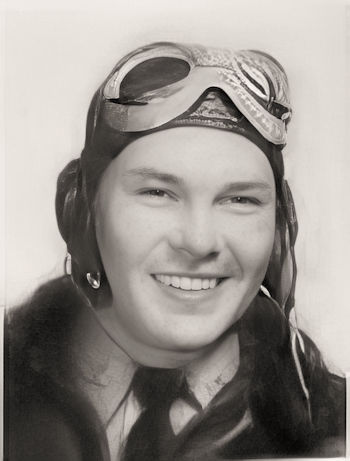
Ted’s graduation photo is shown in the 1944 NAS Norman, OK, yearbook named “Sky Anchors Aweigh.” His addresses is listed as Revere, MA, where he lived with his wife. He was a very handsome young man with a mesmerizing smile.
From Norman, OK, Ted was transferred to US Naval Air Training Center, Corpus Christi, TX. He arrived there on Jul 30, 1944 for additional classroom and flight training.
After two months in TX, he transferred to Naval Air Training Station, Pensacola, FL. He earned his wings and was commissioned Ensign in Jan 1945.
On leave in Jun 1945, Ted visited his sister, Patricia Case, in Las Cruces, NM. This is the last time she would see him.
From Pensacola, he transferred to his old ship Indianapolis and went aboard Jun 25, 1945. As a aviation pilot, Ensign Sikes would have flown the Curtis SC-1 Seahawk. These floatplanes launched by catapult, landed in the sea and were brought on board by the ship’s crane. The aviation pilots formed Cruiser Scouting Squadron (VCS) 4.
Reference is made to gunnery training exercises on Indianapolis as she sailed from Mare Island, CA to Guam, departing Jul 16, 1945. “One of the ship’s observation planes towed behind it a brightly colored sleeve, a kind of long windsock, and Indy’s guns blasted away at it.” This exercise took place almost daily. (Vincent & Vladic)
Indianapolis had arrived at Guam after delivering her top secret cargo to Tinian, Northern Mariana Islands. Her delivery contained components of the atomic bomb that would be dropped on Hiroshima.
She departed Guam on the morning of July 28, 1945, bound for Leyte, central Philippines. Two days into the journey Indianapolis was sunk by two torpedoes fired from Japanese submarine I-58. She sank in 12 minutes. Ted was lost at sea.
Ted’s mother, Mrs. Grace Sikes, resided in Altus, OK having formerly lived in Coalgate, OK. One of Ted’s other sisters, Ruby O. Sikes, completed officers training at Des Moines, IA and was commissioned on Aug 18, 1945, as a 2nd Lieutenant in the Women's Army Auxiliary Corps (WAAC), just after her brother’s loss.
Ted, you are not forgotten.
Ted was the youngest of eight children born to William Henry and Grace Irene Pursley Sikes. His father was 64 years old when Ted was born and his mother was 38.
His siblings were Henry A., John W., Martha V. (Raymond), Irene Patricia (Case), Elizabeth D. C. (Renfro), Juanita H. (Amberster) and Ruby Opal Sikes.
According to the 1940 US Colorado Census, Ted was born in New Mexico and lived with his mother and brother at 814 Tillotson Street, Trinidad, Los Animas Co., CO. This census was enumerated Apr 12, 1940 and notes his age as 17 years and had completed 3 years of high school. This listing followed the rules of the census in recording the age at last birthday and highest grade of high school completed at the time of the census. Ted had completed the 11th grade, but was now a senior in high school.
Ted graduated from Trinidad High School on May 29, 1940. His senior yearbook shows he was very athletic. He played football, ran track and cross country as well as intramural sports. In his early years of school he was a member of the band and orchestra. Also, he completed a college preparatory class.
Four months after graduation, he entered the USN. He was 18 years old.
After completing basic training in San Diego, CA, Ted was assigned to USS Indianapolis. The ship was in Pearl Harbor so Ted traveled almost 3,400 nautical miles of the Pacific Ocean on board USS Dewey DD-349 to Pearl Harbor. After a nine day journey he arrived and went aboard Indianapolis the following day, Oct 11, 1940. He went on board as a Apprentice Seaman (AS) but quickly advanced to the rate of S2/c on Dec 6, 1940. On May 1,1941 his rate advanced to S1/c.
Ted’s father, William Henry Sikes, passed away in a hospital in Charlottesville City, Albemarle Co., VA, on Jan 19, 1941, at age 82, while Ted was serving on board Indianapolis. Mr. Sikes was a resident of Waynesboro, Augusta Co., VA and most likely living with his oldest son, Henry A. Sikes, Ted's brother.
Ted remained on board Indianapolis for ten months until August 1941 when he was transferred to attend Elementary Fire Control School, San Diego, CA. The ship was at Pearl Harbor when Ted left her so he embarked on another long voyage that began on August 2, 1941 on board USS Sabine AO-25. Upon arrival he made his way to training school at San Diego on Aug 15, 1941.
By Dec 8, 1941, he had completed Fire Control School. He reversed his voyage on board USS Harris AP-8 in San Diego for transfer back to Indianapolis, still stationed in Pearl Harbor. Harris arrived at Pearl Harbor on Christmas Eve, Dec 24, 1941. He reported aboard Indianapolis on Dec 27, 1941.
Ted’s Fire Control training would continue while back on board Indianapolis. After schooling and two long voyages, Ted’s mission was fulfilled when his rating was advanced on Feb 1, 1942 to FC3/c(M) - Fire Control 3rd Class. Fire controlmen were highly skilled technicians responsible for the operation of various forms of range finding gear as well as the solving of ballistics calculations to control the firing of the ship's guns. Also, they inspected, maintained and repaired fire control instruments, operated rangefinders and optical fire control equipment and repaired electrical firing circuits. Ted was now qualified to man fire control stations in action. Fire controlmen 1st, 2nd and 3rd class were divided into FC(M) (maintenance) and FC(R) (repair).
He would very shortly put his new skills to use.
“Her [Indianapolis] first action came in the South Pacific deep in enemy-dominated waters about 350 miles south of Rabaul, New Britain. Late in the afternoon of 20 February 1942, the American ships [Task Force 11] were attacked by 18 twin-engined bombers, flying in two waves. In the battle that followed, 16 of the planes were shot down by accurate antiaircraft fire of the ships and fighter planes from Lexington (CV-2). All ships escaped damage and they splashed two trailing Japanese seaplanes.” [DANFS]
Ted remained on board Indianapolis at Pearl Harbor until late March 1942 when he was transferred, but not before his ship again saw enemy action.
“On 10 March 1942 the Task Force, reinforced by carrier USS Yorktown (CV-5) attacked enemy ports at Lae and Salamaua, New Guinea, where the enemy was marshaling amphibious forces. Carrier-based planes achieved complete surprise by flying in from the south, crossing the high Owen Stanley mountain range, and swooping in to strike Japanese harbor shipping. As they inflicted heavy damage on Japanese warships and transports, the American flyers knocked down many of the enemy planes which rose to protect the ports. American losses were exceptionally light.” [DANFS]
His new assignment would be on USS Massachusetts BB-59, newly launched on Sept 23, 1941 at Quincy, MA. She was to be delivered to Boston Navy Yard in Apr 1942 and commissioned May 1942.
Indianapolis was returning to the US and Ted is listed as a passenger on his own ship. When he arrived in the US he was transferred off Indianapolis Apr 8, 1942 for the receiving station in San Francisco, CA. He arrived in Boston, MA Apr 14, 1942 and from there was transferred to Massachusetts where he went aboard May 12, 1942, just in time for her commissioning ceremony. He became a Plankowner of the ship, meaning he was on board at commissioning.
In six short months, Ted would find himself back in combat. Massachusetts’ first battle action was on Nov 8, 1942 during the invasion of North Africa as part of the USN's "Operation Torch." Off the city of Casablanca, Morocco, the ship engaged in a battle with a French battleship. She fired the first 16" projectile of WWII, in battle conditions. Four more projectiles resulted in the sinking of the foreign enemy battleship.
Ted wrote a letter home to his mother describing the events of this day, as well as previous events. It was published in the Coalgate, Oklahoma Record Register newspaper on Dec 31, 1942 and titled, “News from The Boys in Service.”
“I went to Casablanca in West Africa. We kicked hell out of things Nov 8. As you probably read, I got a scratch on the right leg. It put me out for a few days, but I soon got over it with no remaining damage. Just a six inch scar.
Boy when this is over I will always be able to say I did my part. Gee, I have more bars than the Admiral himself, -almost-. Three battles in the South Pacific and one here gives me six bars and five medals We won't get the medals until after the war, so by then I may have a chest full. In the last battle, we were hit three times, damage slight, casualties few. My battle station was struck by fragments from a close miss. They did very little damage but the concussion from the burst checked most of us. I was knocked to my knees, others had broken ankles, and some had lumps on their heads from bouncing off the overhead. We shorter men got by pretty easy.”
Ted remained on Massachusetts until Dec 10, 1942 when he was transferred to aircraft carrier, USS Independence CV-22 where he arrived for duty on Jan 15, 1943, just one day after the ship was commissioned. For a second time he became a Plankowner of a new ship.
Perhaps it was his experience on this aircraft carrier that fueled his desire to become a pilot. He remained on Independence until Apr 8, 1943 when he agreed to extend his enlistment for 2 years. The same day he transferred to Receiving Station, Norfolk, VA for forwarding to the Naval Aviation Cadet Selection Board (NACSB), University of Washington, Seattle where he was received May 3, 1943.
Report of Changes for NACSB shows on Jun 4, 1943 he was “discharged” from the USN by "Special Order Disc". On June 5, 1943 he is noted as “received for enlistment", Seattle, WA as Aviation Cadet (AVCad), V-5, and two days later was transferred to NFPS, Murray State Teachers College, Murray, KY, a Navy Pre-flight School. This school was classroom teaching only and Ted completed the program in late August.
On Sept 3, 1943 he was received back at Seattle. A pre-flight school had opened recently at St. Mary’s College of California and on Nov 17, 1943 Ted was transferred there for additional training.
Three months later, on Feb 23, 1944, Ted was received at Naval Air Station, Norman OK, for Primary Flight Training. The official Navy log shows him listed as V-5 USNR, not USN. When Ted re-enlisted his commission changed from USN to USNR as was the regulation for all V-5 aviation cadets at the time. In all records going forward, he was noted as USNR with an enlistment date Jun 5, 1943.
Ted’s graduation photo is shown in the 1944 NAS Norman, OK, yearbook named “Sky Anchors Aweigh.” His addresses is listed as Revere, MA, where he lived with his wife. He was a very handsome young man with a mesmerizing smile.
From Norman, OK, Ted was transferred to US Naval Air Training Center, Corpus Christi, TX. He arrived there on Jul 30, 1944 for additional classroom and flight training.
After two months in TX, he transferred to Naval Air Training Station, Pensacola, FL. He earned his wings and was commissioned Ensign in Jan 1945.
On leave in Jun 1945, Ted visited his sister, Patricia Case, in Las Cruces, NM. This is the last time she would see him.
From Pensacola, he transferred to his old ship Indianapolis and went aboard Jun 25, 1945. As a aviation pilot, Ensign Sikes would have flown the Curtis SC-1 Seahawk. These floatplanes launched by catapult, landed in the sea and were brought on board by the ship’s crane. The aviation pilots formed Cruiser Scouting Squadron (VCS) 4.
Reference is made to gunnery training exercises on Indianapolis as she sailed from Mare Island, CA to Guam, departing Jul 16, 1945. “One of the ship’s observation planes towed behind it a brightly colored sleeve, a kind of long windsock, and Indy’s guns blasted away at it.” This exercise took place almost daily. (Vincent & Vladic)
Indianapolis had arrived at Guam after delivering her top secret cargo to Tinian, Northern Mariana Islands. Her delivery contained components of the atomic bomb that would be dropped on Hiroshima.
She departed Guam on the morning of July 28, 1945, bound for Leyte, central Philippines. Two days into the journey Indianapolis was sunk by two torpedoes fired from Japanese submarine I-58. She sank in 12 minutes. Ted was lost at sea.
Ted’s mother, Mrs. Grace Sikes, resided in Altus, OK having formerly lived in Coalgate, OK. One of Ted’s other sisters, Ruby O. Sikes, completed officers training at Des Moines, IA and was commissioned on Aug 18, 1945, as a 2nd Lieutenant in the Women's Army Auxiliary Corps (WAAC), just after her brother’s loss.
Ted, you are not forgotten.