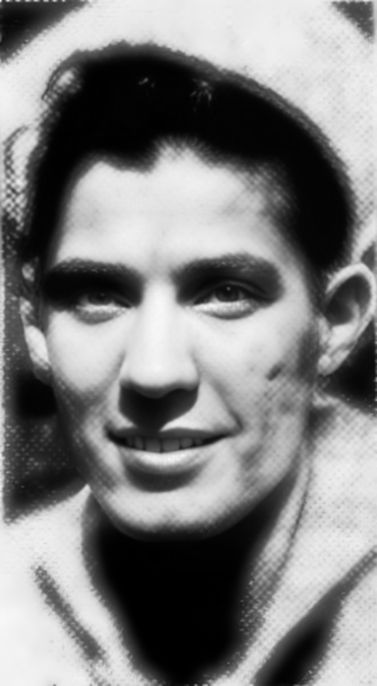
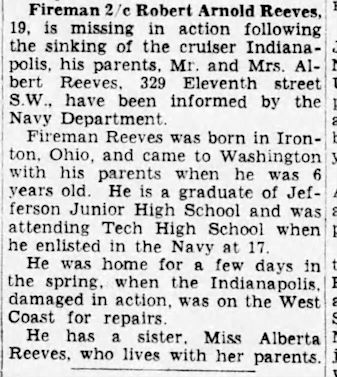
The same day he enlisted, Robert arrived at the Naval Training Station at Sampson, NY. After almost two months of bootcamp, he was advanced from AS (Apprentice Seaman) to F3c (Fireman 3rd class). He continued to perform well and was advanced to F2c (Fireman 2nd class) on Jan 1, 1944. On Jan 14, 1944, he was transferred to the receiving station at Washington, DC.
The following day, Robert was assigned his first ship. When he saw her for the first time it was likely not at all what he expected to see. He must have wondered what kind of ship it was.
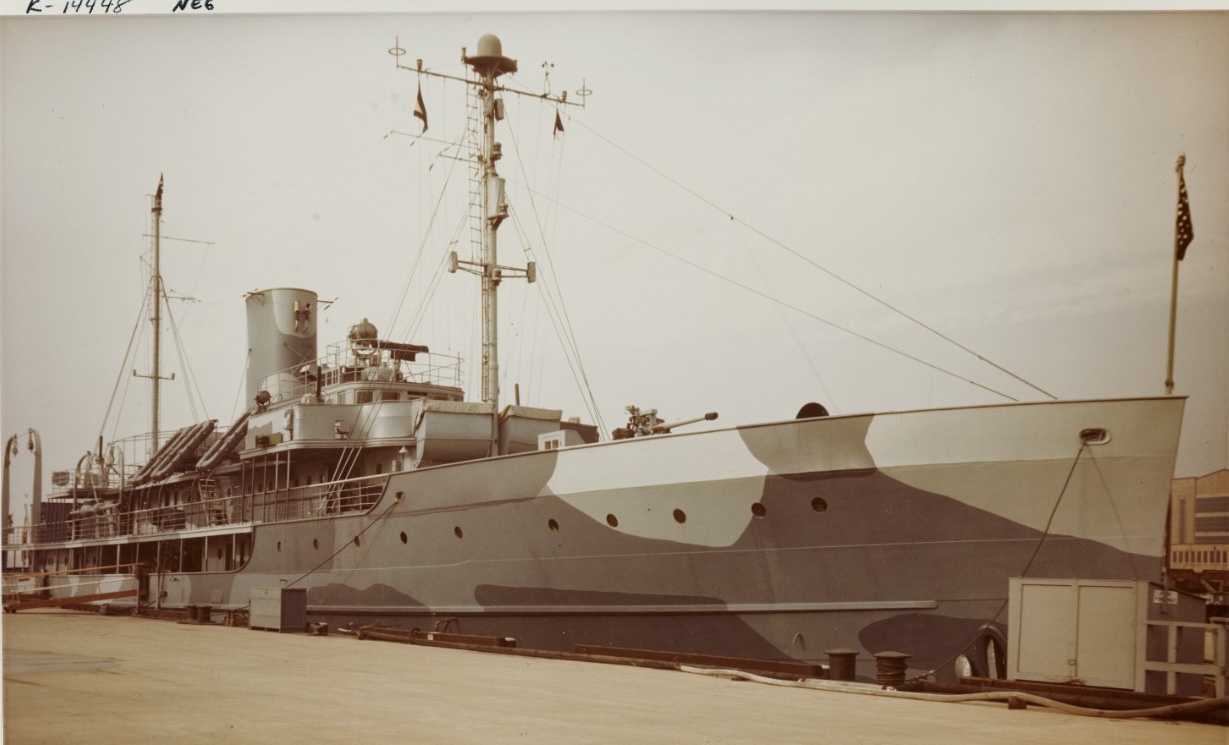
His new home was originally a luxury personal yacht named Delphine and acquired by the USN in Jan 1942. She was gutted and reconfigured to accommodate more crewmen as well as refitted as a gunboat. Her once white exterior was painted with a camouflage pattern. A photo of the ship, below, was taken c1944-1945. She was armed with 2 3"/50 dual purpose gun mounts. Her length was 257' with a beam of 35' and she carried a complement of 135 men that included a Marine detachment.
She was commissioned in Michigan on May 11, 1942 as USS Dauntless PG-61. She arrived in Washington, DC, on June 16, 1942 and replaced USS Vixen PG-53 as the flagship for Admiral Ernest King, Commander-in-Chief of the US Fleet and Chief of Naval Operations. She was specifically moored to Pier #1 at the Washington Navy Yard. King "lived on board his flagship during World War II, because it was quiet and free of distractions" and from there he planned and coordinated the naval war.
Dauntless was powered by three 250psi Babcock and Wilcox boilers, two 3,000ihp (Indicated Horsepower) vertical quadruple expansion Great Lakes Engine Works engines and two shafts. The ship had been launched in 1921, so how much training Robert had for this type engine and auxiliary components is unknown. It was not the engine used in traditional naval combatants.
A F2c was normally assigned to the engineering department in the engine room, but this was the Navy's operating practice on larger naval vessels. There was likely not a true engineering division on this ship. Regardless, there is little doubt Robert was intelligent and capable. The Navy carefully selected the men who served on this prestigious ship. Admiral King was the highest-ranking officer within the wartime Navy command structure alongside Admiral Chester W. Nimitz.
For the next ten months, Robert would assist in maintaining the unique expanding high-pressure steam engines and other components of the propulsion system to ensure the ship was ready to sail at a moments notice. Also, he would assist with minor repairs. How often the ship left her berth, if at all, is unknown to this researcher.
When Robert was transferred from Dauntless on Nov 6, 1944, he could not have imagined his next duty station. His service on the flagship in the Potomac River was relatively calm and quiet and he had likely never been to sea. His new assignment would not be so tranquil.
The train was used to move servicemen around the country and Robert's trip from DC to CA probably took 4-6 days or longer. He arrived Dec 1, 1944, at the receiving barracks at Shoemaker, CA, and was sent that same day to his new ship - USS Indianapolis CA-35. She was at berth at Mare Island, Vallejo, CA, for overhaul and refitting following service in the Pacific.
The Portland Class heavy cruiser was huge with a length of 610 ft. (202 yards) and a beam of 66 ft. Her height towered 133 ft. from her waterline to the top of her radar antennae. She had been described by some sailors as the most beautiful ship they had ever seen.
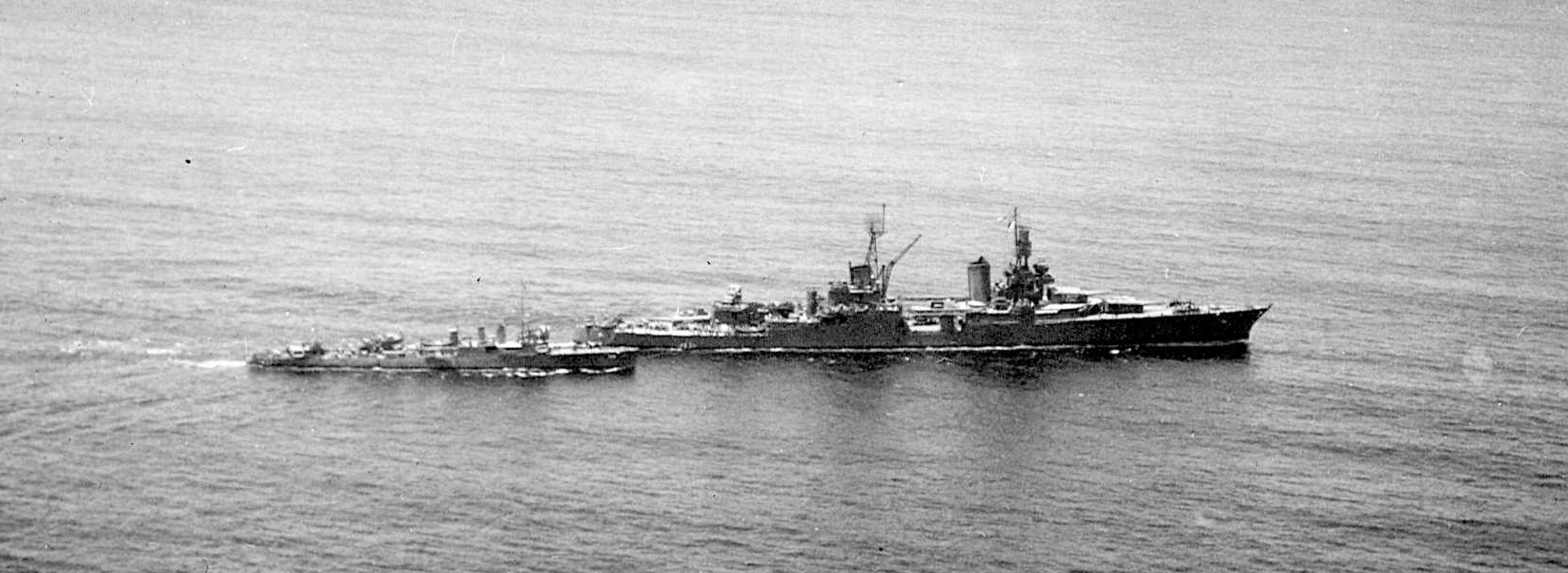
With his former ship only 86 yards in length and having a complement of 135 men, no doubt Robert was overwhelmed when he joined Indy's crew of over 1,200 enlisted and officers. He would need a map to find his way around the ship. For comparison, a photo, below, shows a destroyer alongside Indianapolis. Robert's former ship was smaller than a destroyer.
Robert was assigned to the Engineering A-Division. Indianapolis had two main engine rooms on the lower deck. Both the forward and after engine rooms were located towards the rear of the ship behind the bridge. They housed four powerful geared turbines engines that drove the four massive propellers. Each engine was driven by the fire room which contained four boilers divided into compartments of two each. Each component of the propulsion system was isolated within a compartment with bulkheads that could be dogged down to make the area watertight in an emergency. The compartments were cramped and the engine noise was deafening. The boiler rooms were unbearably hot with little air circulation.
He had been on board for only 4 weeks when Indianapolis departed Mare Island on Jan 3, 1945, bound for Pearl Harbor. Training exercises were held while en route and more would be conducted in the waters off Pearl Harbor. Admiral Raymond Spruance came aboard Indianapolis on Jan 20, 1945, and hoisted his flag. Serving on the flagship of the Fifth Fleet was quite an honor for Robert and his shipmates. Although he had the same honor on board USS Dauntless, this time was different. Robert was headed for service in the war zone.
Indianapolis arrived at Ulithi Lagoon on Jan 26, 1945 and would remain until Jan 31st. She joined Vice Adm. Mitscher's fast carrier Task Force 58 on Feb 14th, two days before it made its first attack on Tokyo. Throughout the action, Indianapolis played her vital role of support ship.
She sailed on to Iwo Jima where action began on Feb 19th. Indianapolis did her share of the bombardment of the island where Japanese soldiers hid in and attacked US forces from subterranean tunnels. She moved back to Tokyo to Honshu and Nansei Shoto for more bombardment of the islands and remained until the operation ended on March 1st. She returned to Ulithi Lagoon.
On March 14, Indy was underway to join Task Group 58.3. Anti-aircraft target practices were conducted during the day. Simulated coordinated air strikes on the Task Group were conducted the following day. Additional exercises were conducted during the following days as the Task Group proceeded toward Okinawa, but it was not clear sailing. Indy fired on an unidentified plane on the morning of March 18th. That afternoon more planes closed the formation. The Task Group Commander ordered radical emergency turns at speed of 25 knots. Indy opened fire on a "Frances" bomber when it approached the center of the disposition, flying at medium altitude and low speed. No kill was determined. "There was no rest at this time, however, as two enemy planes were reported closing the disposition...", according to the War Diary. Indy's guns again opened fire on a enemy "Judy" bomber as she approached close aboard to port headed directly at USS Bunker Hill. The planes dropped its bombs but missed Bunker Hill and then crashed into the sea. On March 19th, "Enemy aircraft were in the vicinity continuously" the following day. Two attack were made on Indy's Task Group. Indy opened fire on a "Zeke" and it was seen falling with a friendly fighter on its tail. Two minutes later Indy fired on an unknown enemy plane that was picked up only one minute before. Her 5-inch shells blew off the tail of the plane. Fifty-eight minutes later Indy opened her guns after spotting a "Judy" bomber diving on USS Essex. It was believed she assisted in the kill. Only thirteen minutes would pass before she trained her guns on another "Judy" that appeared almost directly overhead. The plane was later reported shot down but Indy's crew did not see it fall. This was the last attack of the day.
The pre-invasion bombardment of Okinawa began March 24th and for 7 days Indianapolis trained her 8-inch guns and bombarded beach defenses. Enemy aircraft filled the sky attacking the ships. Indy shot down six planes and assisted in splashing two others. However, it was on the 7th day, March 31st, that Indianapolis was hit by a Japanese kamikaze plane. The attack was so sudden that there was little time to react. Eight of Indy's 20-millimeter guns managed to fire only one magazine each, but it was enough. The gunners saw tracers enter the plane and believed this caused the plane to swerve and strike a glancing blow to the port side of the after main deck causing little damage. However, the bomb carried by the plane released, plummeted through the ship and exploded in the water beneath the hull. One of the crew's mess halls, a berthing compartment below it and fuel tanks were severely damaged as the bomb passed through and the explosion created two huge holes in the hull caused flooding of some compartments. Nine crew members were killed. Twenty or more men were injured but Robert was not among them. Though uninjured, Robert must have feared for his life as the ship shuttered and heaved when the bomb exploded. If he was in the one of the engine compartments, he would have assisted in dogging down the hatches until the extent of the damage was known.
After temporary repairs, Indy limped back to Mare Island, CA, for repairs and refitting that would take two-and-a-half months to complete. Robert was granted leave and returned home to visit his family. There was likely not enough time to tell them everywhere he had been and dangers he had faced. The rest of the story would have to wait until the war ended and he was home for good.
Since boarding, Robert had been awarded two stars to place on his Asiatic-Pacific ribbon representing the two battle stars awarded to Indianapolis during his service on board.
With repairs and overhaul nearly completed, Robert and his shipmates prepared for a top-secret delivery to the island of Tinian in the Northern Mariana Islands. When they departed Hunter's Point Navy Yard in San Francisco on July 16, 1945, no one on board knew they were transporting the components of the atomic bomb that would later be dropped on Hiroshima.
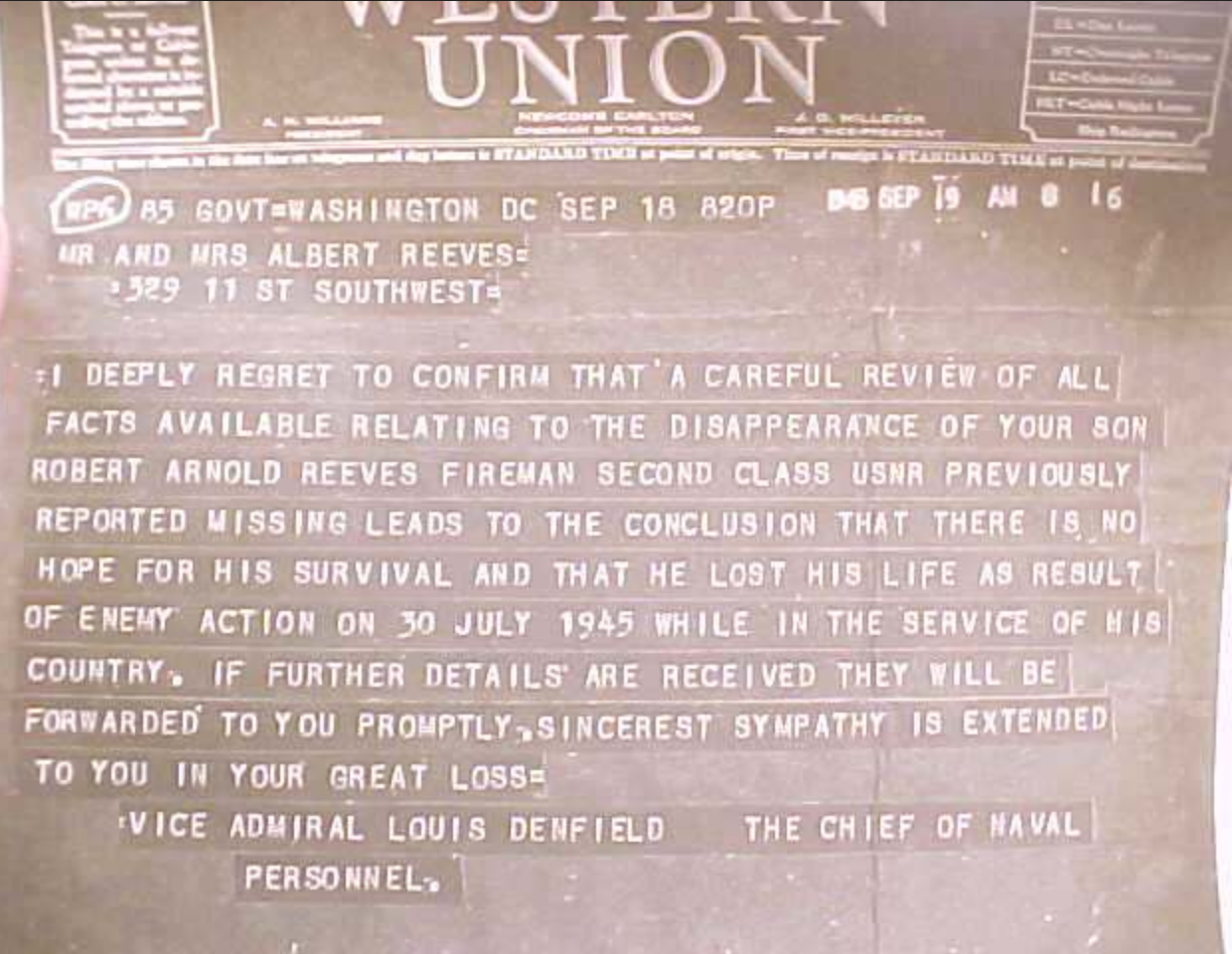
After the delivery, Indianapolis departed Tinian and after a short stop at Apra Harbor, Guam, she sailed on July 27th to Leyte, her final destination. Half-way to Leyte Indy was struck by two torpedoes from Japanese submarine I-58 on July 30, 1945 and sank in 12 minutes. It is not known if Robert made it off the ship into the water.
He had served in the USN for 1 year and 9 months at the time of his death and had turned 19 years old only one week before the sinking of the ship. His family would never hear the rest of his stories.
Robert, you are not forgotten.
He was awarded the Purple Heart, posthumously.
Robert was eligible for the WWII Victory medal.
His family may request the Combat Action ribbon which was approved in 1999 and made retroactive to Dec 7, 1941.
On Jan 30, 2001, the Navy approved a Navy Unit Commendation for the period July 16 to July 26, 1945.
In July 2020, the Congressional Gold Medal, the highest civilian award, was awarded to the crew members of Indianapolis.
His name is inscribed on the Tablets of the Missing in the Manila American Cemetery, Fort Bonifacio, Taguig, Philippines and the USS Indianapolis National Memorial, Indianapolis, IN.
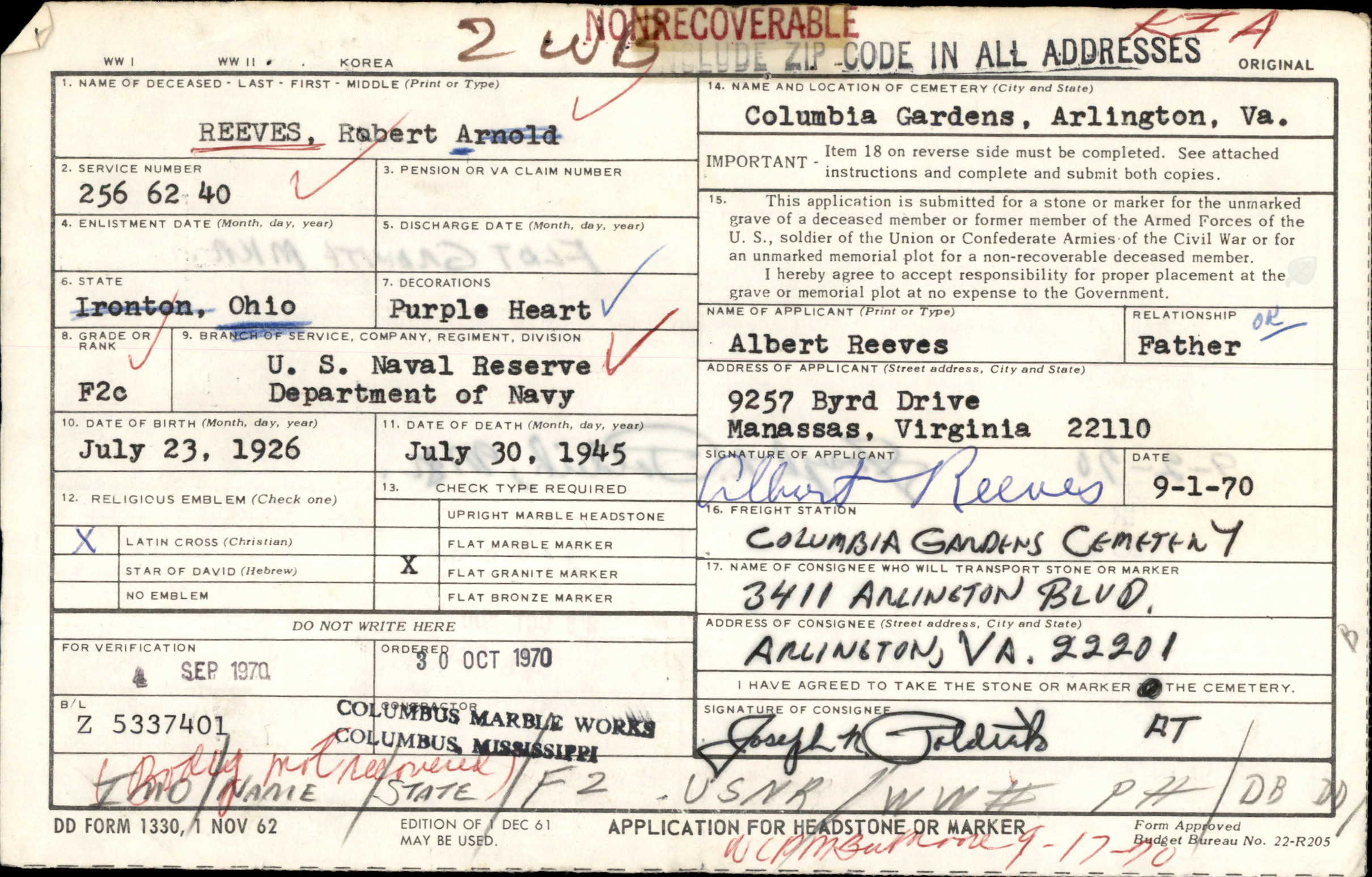
A beautiful flat granite cenotaph was placed by his parents in the Columbia Gardens Cemetery, Arlington, VA.
Source Credits1950 US Census, Dist. of Columbia, Washington. Enumerated April 12, 1950. HH# 331; citing family of Albert Reeves.
Buell, Thomas B. (1980). Master of Sea Power: A Biography of Fleet Admiral Ernest J. King; Little, Brown, and Co., Boston, p. 144.
Eger, Christopher. Warship Wednesday Sept 2, 2015: Dodge's Dauntless Delphine.
https://laststandonzombieisland.com/2015/09/02/warship-wednesday-sept-2-2015-dodges-dauntless-delphine/
USN training station rolls, deck logs and war diaries. Online at Ancestry.com and NARA.gov.
US Government, Department of Veterans Affairs, Application for Memorial Grave Marker; citing headstone application submitted by Albert Reeves, Sept 1, 1970. Flat Granite Marker. Columbia Gardens Cemetery, Arlington, VA.
Navy Department, Casualty Section, Office of Public Information (1946): Combat Connected Naval Casualties, WWII, by States; Vol. AL-MO; DC, p. 5; citing Robert Arnold Reeves, F2c, s/o Mr & Mrs Albert Reeves, 329 11th St. S.W.
usmilitariaforum.com; items posted by t_player, 13 Aug 2013 that include an envelope from a letter written home by Robert. The return address shows "F2c, A-Division."
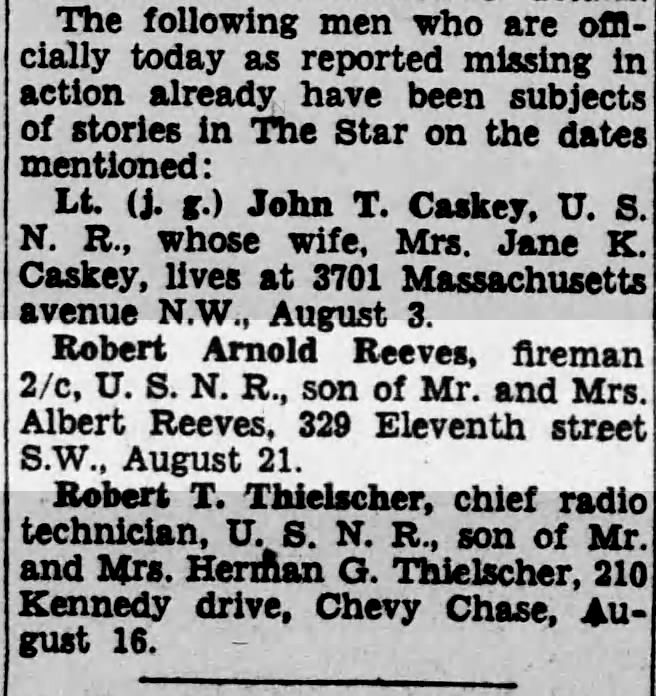
The Evening Star, (Washington, DC), Tue, Aug 21, 1945, p. 2; citing Albert Reeves, MIA
The Evening Star, (Washington D.C), Mon., Sept. 10, 1945, p. 2.; citing Albert Reeves LAS
 Rank / Rating: F2-Fireman Second Class