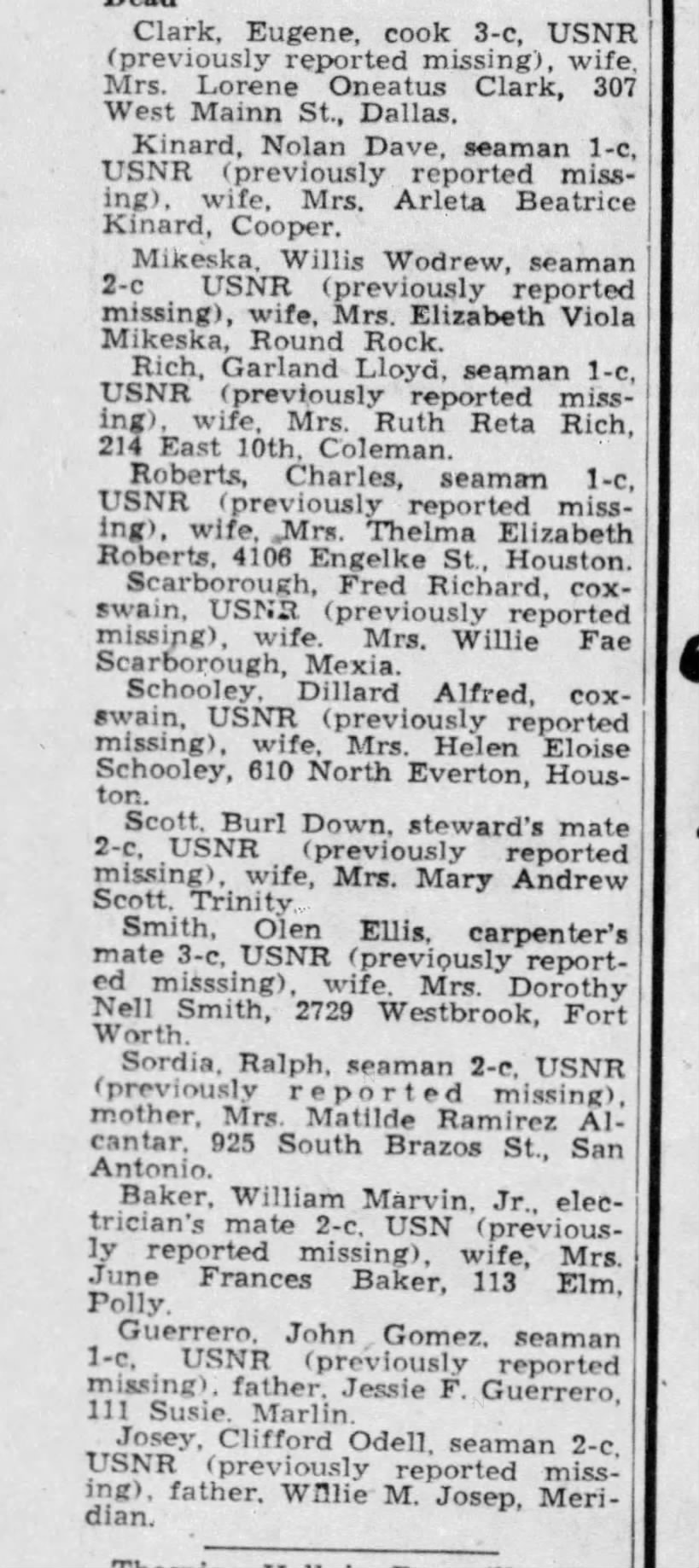
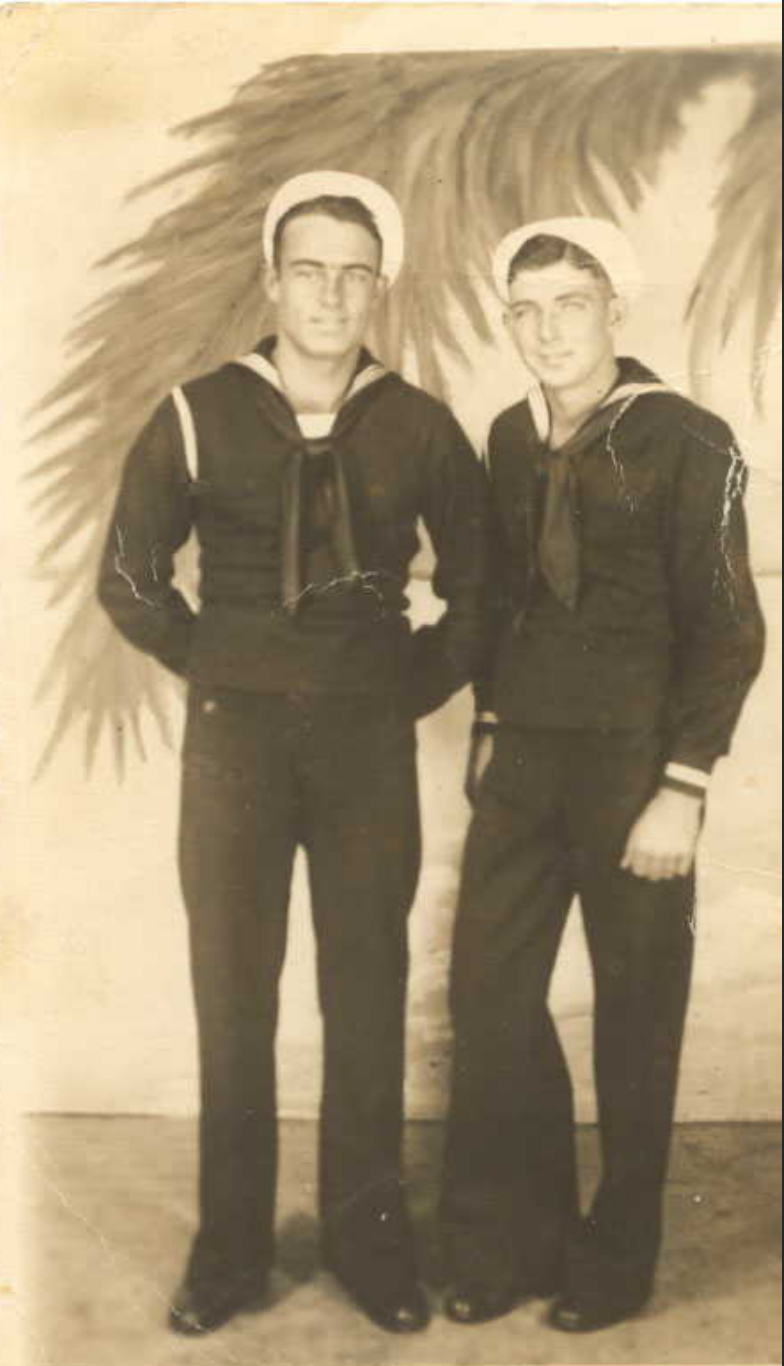
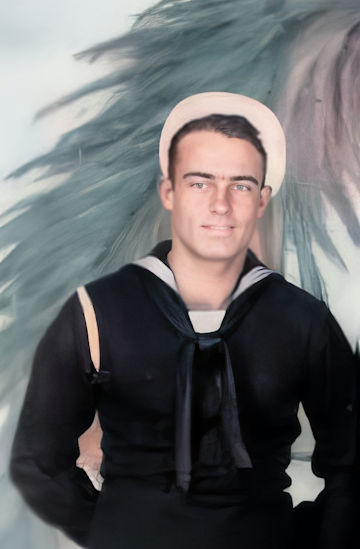
Rank / Rating: S1-Seaman First Class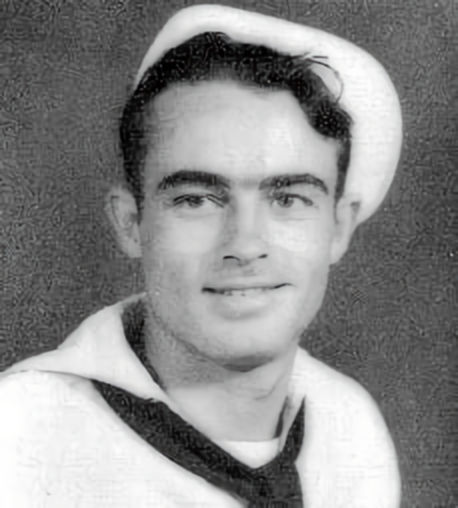
 Nolan's father remarried three months later. Nolan would have two step-brothers born of this marriage. The second, Harold Wayne Kinard, was born in 1945, the year that Nolan died.
The 1940 census shows Nolan living with his father, step-mother and siblings in Delta County, TX. Nolan was 21 years old and working as a truck driver. His high level of education was 1 year of high school. The census asked where the family was living on April 1, 1935 and Gregg Co., TX is noted for everyone but Nolan. He stated he was living in Titus County, TX on April 1, 1935. This census was enumerated April 12, 1940.
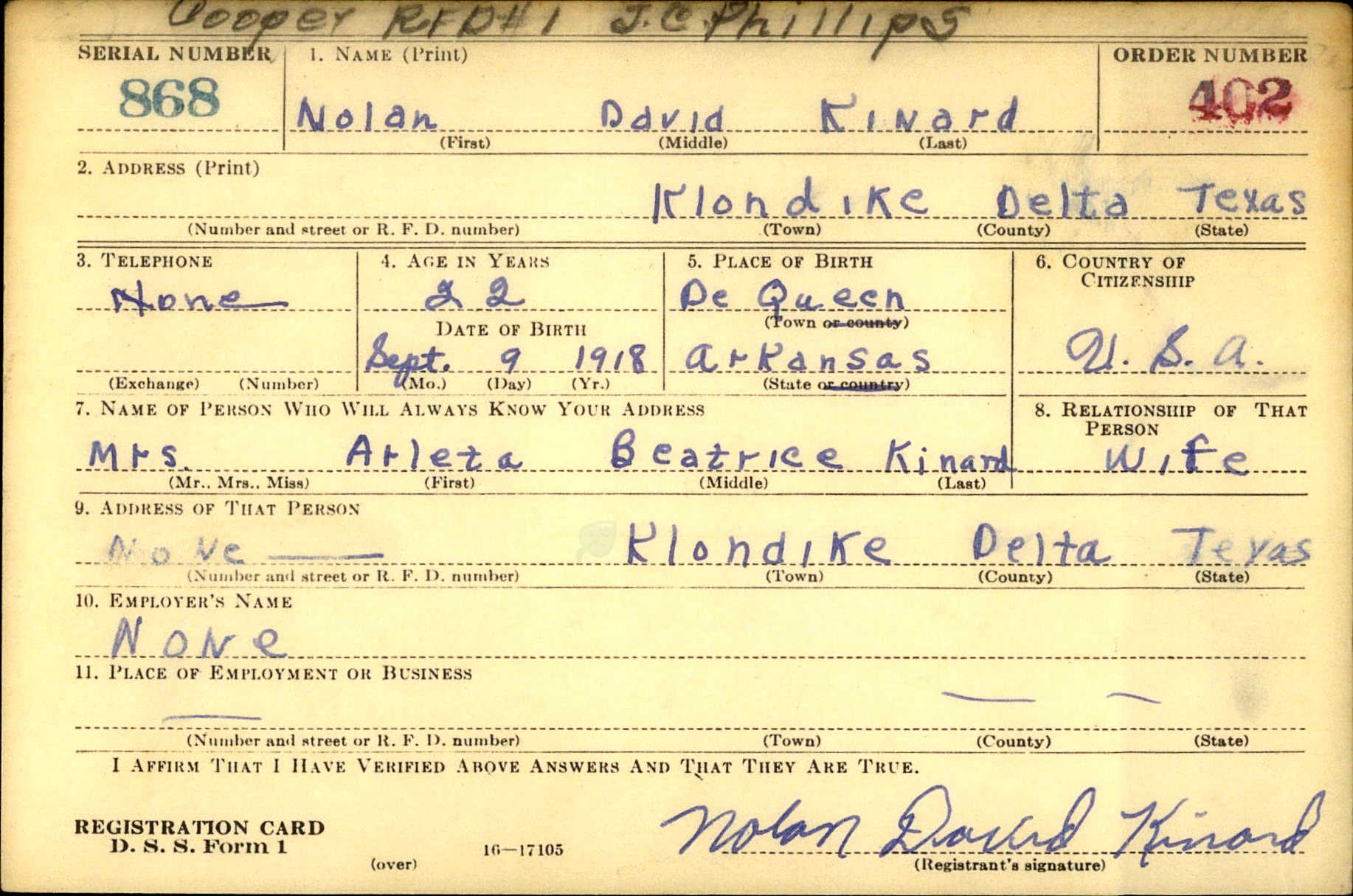
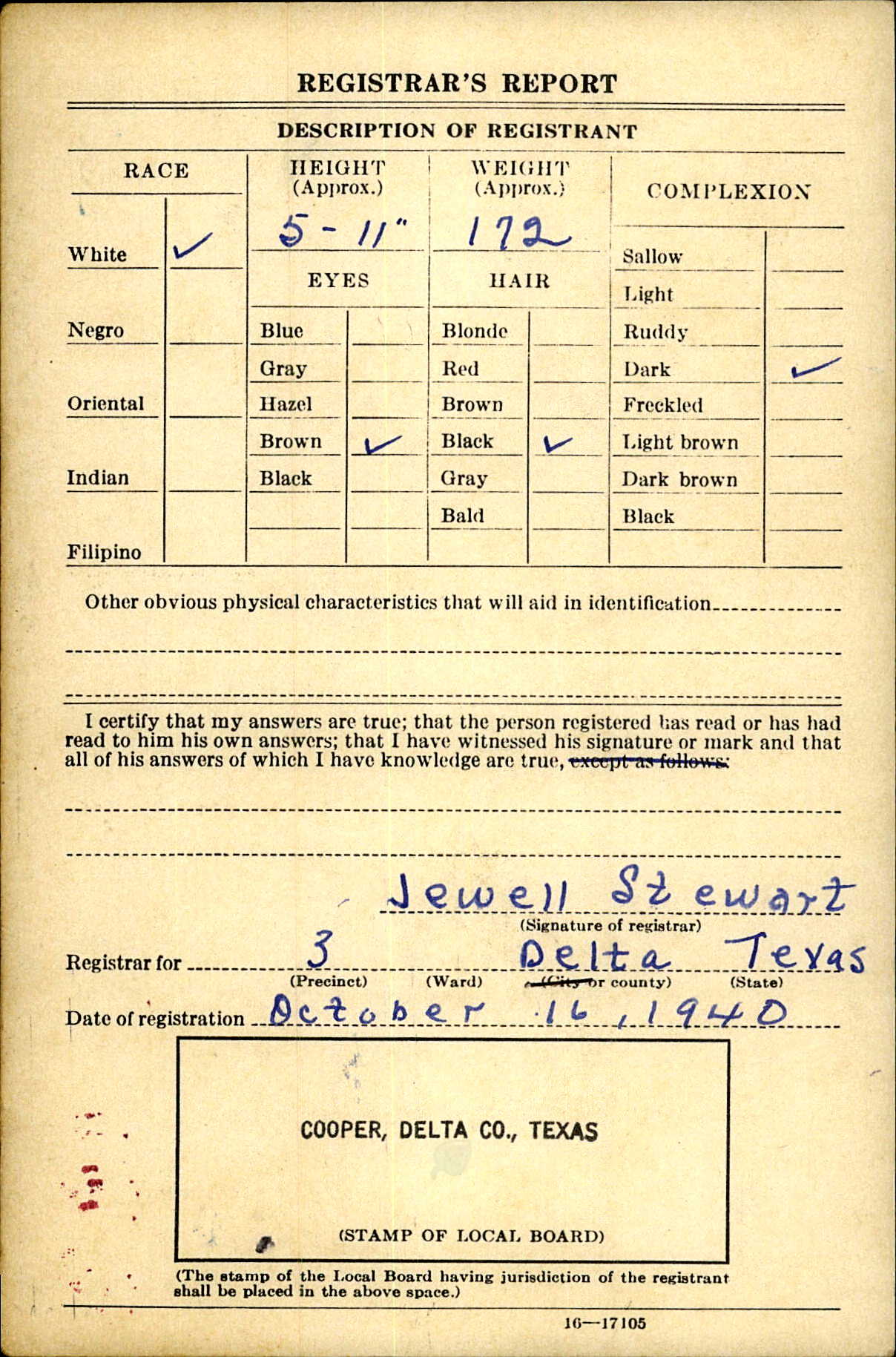
Two months after the census was enumerated, Noland married Arleta Beatrice Phillips on June 11, 1940 in Texarkana, Bowie Co., TX. His happy marriage would be overshadowed by the Selective Training and Service Act of 1940 that was enacted on Oct 16, 1940. He was required to register on that day. He was 22 years old.
It is not known if he was mailed a notice from the draft board. At the time, he still had the option to enlist rather than be drafted. Nolan made his decision and enlisted in the USN on Nov 21, 1942 at Little Rock, Ark. He said goodbye to his new bride and family and six days later, Nov 27th, he arrived at the Naval Training Station, San Diego, CA, for boot camp.
"I was a young teenager when Nolan left to serve our country. I fondly remember him as such a gentle man, who always put others first before himself. He was so proud that he could join the Navy and help fight for the freedom that he so cherished. When Nolan came home on leave he would spend as much time with our family and daddy as he could. He would stay with daddy until daddy went to bed, and only then he would leave to visit his friends and other family members."
After eight weeks at bootcamp Nolan was advanced from AS (Apprentice Seaman) to S2c (Seaman second class) on Jan 28, 1943. For an unknown reason, Nolan remained at the San Diego training station for three more months. It is likely that he received additional training but no records were located. He was transferred on April 26, 1943 to the receiving station in San Francisco, CA where he arrived the following day.
At San Francisco, Nolan was received aboard USS Indianapolis CA-35 on April 29, 1943. It would be only five days before he went to sea for the first time. The ship left port and headed to Adak, Alaska where she arrived on May 25th. Nothing had prepared Nolan for the conditions he would endure. The weather in the Pacific and Bering Sea was dreadfully cold and unforgiving. The seas rolled with torrents of rain, high winds, sleet and snow. Sudden strong storms presented a constant threat to the ship and her crew.
Nolan took part in his first battle action when Indianapolis joined the other small ships of the task force and trained her 8-inch guns on Little Kiska, Island on Aug 2nd, destroying shore-based Japanese hideouts and other facilities.
As part of TG 16.6.2, on Aug 12th, Indy launched her four planes to serve as spotters shortly before she trained her main battery on Gertrude Cove, Kiska Island. She then trained her 5" battery at Bukti Point on Kiska. There was no return fire and all planes were recovered.
Although the battle actions had ended, Indy remained on patrol and in a supportive roll in the Aleutians. She finally returned to anchor in Kuluk Bay, Adak, AK, on Aug 22nd. Her actions contributed to the US reclaiming and occupying Attu and other islands in the Aleutians.
On Aug 25th she departed for San Francisco for overhaul and refitting. Basically, Nolan's feet had not been on land for almost four months, but he had earned his first battle star.
At San Francisco there would be no time for leave or much time ashore. Indy sailed for Pearl Harbor on Sept 7th. She would remain there and conduct training exercises until early November. At Hawaii, Nolan would have his first experience on board a flag ship when Vice Admiral, later Admiral, Raymond A. Spruance came back on board Indianapolis as Commander of the Central Pacific Force.
Nolan headed for further battle action when Indy steamed from Pearl Harbor on Nov 10th bound for the Gilbert Islands, Central Pacific, and "Operation Galvanic" against Tarawa and Makin islands. On Nov 19, 1943, Indianapolis, in a force of cruisers, bombarded Tarawa and the next day pounded Makin. The ship then returned to Tarawa and acted as a fire-support ship for the landings. "That day her guns splashed an enemy plane and shelled enemy strong points as valiant landing parties struggled against fanatical Japanese defenders in an extremely bloody and costly battle. She continued this role until the leveled island was declared secure 3 days later." [DANFS]
Indianapolis returned to Pearl Harbor on Dec 11, 1943 where 366 enlisted men and 52 officers disembarked to remain at Pearl until Indy returned. Indy took aboard 698 passengers and steamed for San Francisco where she arrived on Dec 18, 1943 and disembarked her passengers before heading to Mare Island, CA.
Indy departed Mare Island on New Year's Day for San Francisco but stayed only long enough to embark officers and passengers for transport to Pearl Harbor where she arrived on Jan 7th, 1944. Crewmembers who had remained at Pearl came back aboard Indy.
She departed the harbor bound for the Marshall Islands to aid in the actions against Kwajalein and Majuro Atolls in late January. Two days before Indy entered Kwajalein lagoon, Nolan was advanced to S1c (Seaman 1st class), Feb 1, 1944. The ship continued service until the area was secured. Her service ended in the Gilberts after supporting the occupation at Eniwetok which was secured on March 2nd. However, she remained in the area until March 22nd patrolling and conducting training exercises. During this time Nolan was "striking" for the rate of Gunner's Mate. He completed the training and received the Navy Training Course Certificate on Apr 1, 1944. However, there is no record that he was ever advanced to this rate. This was most likely due to there being enough Gunner's Mates on board and he would have to wait until there was an open position. However, he was allowed to perform the functions of a Gunner's Mate but with no increase in pay. Unfortunately, this was not an uncommon practice at this point in the war. Nolan could be proud of his accomplishment, and his skills would soon be demonstrated.
Steaming to the Western Carolinas, Indy took part in the raids on Palau, Yap, Ulithi and Woleai. The day before she began the bombardment of Palau, Indy opened fire on an enemy torpedo plane approaching the ship on the port beam at close range. The plane burst into flames, crossed about 150 yards ahead and was seen to crash into the water about 1,000 yards on the starboard beam. No doubt Nolan celebrated this victory with his shipmates.
On April 10th, after three months at sea, the ship left Majuro for Pearl Harbor and on April 22nd she arrived back in San Francisco, CA. Nolan was not likely granted furlough because Indy would be in port only eight days before steaming back to Pearl Harbor on May 1st.
When Indy returned to the Pacific in early June, the Central Pacific Force in which she formerly served was now designated the Pacific 5th Fleet and continued under the command of now Admiral Spruance. This would be a period of brutal service for Nolan. From June to Sept 29, 1944, Indy took part in the capture and occupation of Saipan, Battle of the Philippine Sea, the capture and occupation of Guam, the capture and occupation of Tinian in the Northern Marianas Islands and on to the Western Caroline Islands operation for the capture and occupation of southern Palau Islands.
Nolan arrived back at Mare Island, CA on Oct 19, 1944 where Indy underwent overhaul following her 4 long months of Pacific service. He would spend Christmas and the beginning of the new year on dry land and likely was granted leave before Indy departed on Jan 3, 1945 for San Francisco, then San Diego and forward to Pearl Harbor. On Jan 20th, Adm. Spruance came back aboard and his flag was raised.
Nolan arrived with his ship on Feb 1, 1945 at Ulithi Atoll, two weeks before she made her first attack on Tokyo on Feb 15th. Throughout the action, Indianapolis played her vital role of support ship. She sailed on to Iwo Jima where action began on the 19th. On that day several Japanese planes attacked the Task Group. Indy was credited with one kill. Nolan watched as the 5" gun blew off the tail section and the plane tumbled into the sea. The ship assisted with another kill, although others ships were firing, so credit was not given for a kill. At Iwo Jima, Indy did her share of the bombardment of the island where Japanese soldiers hid in and attacked US forces from subterranean tunnels. She moved back to Tokyo to Honshu and Nansei Shoto for more bombardment of the islands and remained until the operation ended on Mar 1st.
The pre-invasion bombardment of Okinawa began Mar 24th and for 7 days Indianapolis either supported operations or bombarded beach defenses. Enemy aircraft filled the sky attacking the ships. Nolan was called to General Quarters several times each day as planes circled the ship and attacked ships nearby. Indy shot down two planes and assisted in splashing two others. This was a day that Nolan would never forget, but tragedy was looming for the ship.
Indianapolis was hit by a Japanese kamikaze plane on Mar 31st. Nine men were killed and 20 injured. The injured did not include Nolan. Indy limped back to Mare Island, CA, for repairs and refitting, where she would remain for two-and-a-half months. Most assuredly, Nolan was granted leave to visit his wife and parents.
Since boarding, Nolan had been awarded a silver star and 4 bronze stars to place on his Asiatic-Pacific ribbon representing the 9 battle stars awarded to Indianapolis during his time in service.
At Mare Island, Nolan and his shipmates prepared for a top-secret delivery to the island of Tinian in the Northern Mariana Islands. No one on board knew the contents of their cargo when they departed on July 16, 1945.
After the delivery, Indianapolis departed Tinian and after a short stop at Apra Habor, Guam, she sailed on July 27th to Leyte, her final destination. Half-way there, Indy was struck by two torpedoes from Japanese submarine I-58 and sank in 12 minutes.
Nolan made it off the ship into the water.
"Nolan's best friend in the Navy was Survivor Robert M. McGuiggan, who was one of the 316 survivors of the USS Indianapolis. I had the pleasure and honor of meeting and talking to Mr. McGuiggan at length about the last day and time that he saw Nolan drifting away in shark infested waters. Our conversation was very emotional as my questions triggered memories that both of us had been long since suppressed. There has never been a true sense of closure to Nolan's life. I have always had and will always have, many unanswered questions as to what happened to Nolan and his shipmates during that horrific ordeal. However, I have the many fond memories of my beloved brother, and I miss him just as much today as the day he left us to report for his last assignment of duty."
Nolan was awarded the Purple Heart, posthumously. His name is inscribed on the Tablets of the Missing in the Manila American Cemetery, Fort Bonifacio, Taguig, Philippines.
Nolan, you are not forgotten.
In addition to his Purple Heart, American Campaign and Asiatic-Pacific ribbons, Nolan was eligible for the WWII Victory medal. Also, his family may request the Combat Action ribbon which was approved in 1999 and made retroactive to Dec 7, 1941.
Note: On his draft registration card he noted his middle name as David and signed his name Nolan David Kinard. Navy records show his middle name as "Dave".
Nolan's father remarried three months later. Nolan would have two step-brothers born of this marriage. The second, Harold Wayne Kinard, was born in 1945, the year that Nolan died.
The 1940 census shows Nolan living with his father, step-mother and siblings in Delta County, TX. Nolan was 21 years old and working as a truck driver. His high level of education was 1 year of high school. The census asked where the family was living on April 1, 1935 and Gregg Co., TX is noted for everyone but Nolan. He stated he was living in Titus County, TX on April 1, 1935. This census was enumerated April 12, 1940.
Two months after the census was enumerated, Noland married Arleta Beatrice Phillips on June 11, 1940 in Texarkana, Bowie Co., TX. His happy marriage would be overshadowed by the Selective Training and Service Act of 1940 that was enacted on Oct 16, 1940. He was required to register on that day. He was 22 years old.
It is not known if he was mailed a notice from the draft board. At the time, he still had the option to enlist rather than be drafted. Nolan made his decision and enlisted in the USN on Nov 21, 1942 at Little Rock, Ark. He said goodbye to his new bride and family and six days later, Nov 27th, he arrived at the Naval Training Station, San Diego, CA, for boot camp.
"I was a young teenager when Nolan left to serve our country. I fondly remember him as such a gentle man, who always put others first before himself. He was so proud that he could join the Navy and help fight for the freedom that he so cherished. When Nolan came home on leave he would spend as much time with our family and daddy as he could. He would stay with daddy until daddy went to bed, and only then he would leave to visit his friends and other family members."
After eight weeks at bootcamp Nolan was advanced from AS (Apprentice Seaman) to S2c (Seaman second class) on Jan 28, 1943. For an unknown reason, Nolan remained at the San Diego training station for three more months. It is likely that he received additional training but no records were located. He was transferred on April 26, 1943 to the receiving station in San Francisco, CA where he arrived the following day.
At San Francisco, Nolan was received aboard USS Indianapolis CA-35 on April 29, 1943. It would be only five days before he went to sea for the first time. The ship left port and headed to Adak, Alaska where she arrived on May 25th. Nothing had prepared Nolan for the conditions he would endure. The weather in the Pacific and Bering Sea was dreadfully cold and unforgiving. The seas rolled with torrents of rain, high winds, sleet and snow. Sudden strong storms presented a constant threat to the ship and her crew.
Nolan took part in his first battle action when Indianapolis joined the other small ships of the task force and trained her 8-inch guns on Little Kiska, Island on Aug 2nd, destroying shore-based Japanese hideouts and other facilities.
As part of TG 16.6.2, on Aug 12th, Indy launched her four planes to serve as spotters shortly before she trained her main battery on Gertrude Cove, Kiska Island. She then trained her 5" battery at Bukti Point on Kiska. There was no return fire and all planes were recovered.
Although the battle actions had ended, Indy remained on patrol and in a supportive roll in the Aleutians. She finally returned to anchor in Kuluk Bay, Adak, AK, on Aug 22nd. Her actions contributed to the US reclaiming and occupying Attu and other islands in the Aleutians.
On Aug 25th she departed for San Francisco for overhaul and refitting. Basically, Nolan's feet had not been on land for almost four months, but he had earned his first battle star.
At San Francisco there would be no time for leave or much time ashore. Indy sailed for Pearl Harbor on Sept 7th. She would remain there and conduct training exercises until early November. At Hawaii, Nolan would have his first experience on board a flag ship when Vice Admiral, later Admiral, Raymond A. Spruance came back on board Indianapolis as Commander of the Central Pacific Force.
Nolan headed for further battle action when Indy steamed from Pearl Harbor on Nov 10th bound for the Gilbert Islands, Central Pacific, and "Operation Galvanic" against Tarawa and Makin islands. On Nov 19, 1943, Indianapolis, in a force of cruisers, bombarded Tarawa and the next day pounded Makin. The ship then returned to Tarawa and acted as a fire-support ship for the landings. "That day her guns splashed an enemy plane and shelled enemy strong points as valiant landing parties struggled against fanatical Japanese defenders in an extremely bloody and costly battle. She continued this role until the leveled island was declared secure 3 days later." [DANFS]
Indianapolis returned to Pearl Harbor on Dec 11, 1943 where 366 enlisted men and 52 officers disembarked to remain at Pearl until Indy returned. Indy took aboard 698 passengers and steamed for San Francisco where she arrived on Dec 18, 1943 and disembarked her passengers before heading to Mare Island, CA.
Indy departed Mare Island on New Year's Day for San Francisco but stayed only long enough to embark officers and passengers for transport to Pearl Harbor where she arrived on Jan 7th, 1944. Crewmembers who had remained at Pearl came back aboard Indy.
She departed the harbor bound for the Marshall Islands to aid in the actions against Kwajalein and Majuro Atolls in late January. Two days before Indy entered Kwajalein lagoon, Nolan was advanced to S1c (Seaman 1st class), Feb 1, 1944. The ship continued service until the area was secured. Her service ended in the Gilberts after supporting the occupation at Eniwetok which was secured on March 2nd. However, she remained in the area until March 22nd patrolling and conducting training exercises. During this time Nolan was "striking" for the rate of Gunner's Mate. He completed the training and received the Navy Training Course Certificate on Apr 1, 1944. However, there is no record that he was ever advanced to this rate. This was most likely due to there being enough Gunner's Mates on board and he would have to wait until there was an open position. However, he was allowed to perform the functions of a Gunner's Mate but with no increase in pay. Unfortunately, this was not an uncommon practice at this point in the war. Nolan could be proud of his accomplishment, and his skills would soon be demonstrated.
Steaming to the Western Carolinas, Indy took part in the raids on Palau, Yap, Ulithi and Woleai. The day before she began the bombardment of Palau, Indy opened fire on an enemy torpedo plane approaching the ship on the port beam at close range. The plane burst into flames, crossed about 150 yards ahead and was seen to crash into the water about 1,000 yards on the starboard beam. No doubt Nolan celebrated this victory with his shipmates.
On April 10th, after three months at sea, the ship left Majuro for Pearl Harbor and on April 22nd she arrived back in San Francisco, CA. Nolan was not likely granted furlough because Indy would be in port only eight days before steaming back to Pearl Harbor on May 1st.
When Indy returned to the Pacific in early June, the Central Pacific Force in which she formerly served was now designated the Pacific 5th Fleet and continued under the command of now Admiral Spruance. This would be a period of brutal service for Nolan. From June to Sept 29, 1944, Indy took part in the capture and occupation of Saipan, Battle of the Philippine Sea, the capture and occupation of Guam, the capture and occupation of Tinian in the Northern Marianas Islands and on to the Western Caroline Islands operation for the capture and occupation of southern Palau Islands.
Nolan arrived back at Mare Island, CA on Oct 19, 1944 where Indy underwent overhaul following her 4 long months of Pacific service. He would spend Christmas and the beginning of the new year on dry land and likely was granted leave before Indy departed on Jan 3, 1945 for San Francisco, then San Diego and forward to Pearl Harbor. On Jan 20th, Adm. Spruance came back aboard and his flag was raised.
Nolan arrived with his ship on Feb 1, 1945 at Ulithi Atoll, two weeks before she made her first attack on Tokyo on Feb 15th. Throughout the action, Indianapolis played her vital role of support ship. She sailed on to Iwo Jima where action began on the 19th. On that day several Japanese planes attacked the Task Group. Indy was credited with one kill. Nolan watched as the 5" gun blew off the tail section and the plane tumbled into the sea. The ship assisted with another kill, although others ships were firing, so credit was not given for a kill. At Iwo Jima, Indy did her share of the bombardment of the island where Japanese soldiers hid in and attacked US forces from subterranean tunnels. She moved back to Tokyo to Honshu and Nansei Shoto for more bombardment of the islands and remained until the operation ended on Mar 1st.
The pre-invasion bombardment of Okinawa began Mar 24th and for 7 days Indianapolis either supported operations or bombarded beach defenses. Enemy aircraft filled the sky attacking the ships. Nolan was called to General Quarters several times each day as planes circled the ship and attacked ships nearby. Indy shot down two planes and assisted in splashing two others. This was a day that Nolan would never forget, but tragedy was looming for the ship.
Indianapolis was hit by a Japanese kamikaze plane on Mar 31st. Nine men were killed and 20 injured. The injured did not include Nolan. Indy limped back to Mare Island, CA, for repairs and refitting, where she would remain for two-and-a-half months. Most assuredly, Nolan was granted leave to visit his wife and parents.
Since boarding, Nolan had been awarded a silver star and 4 bronze stars to place on his Asiatic-Pacific ribbon representing the 9 battle stars awarded to Indianapolis during his time in service.
At Mare Island, Nolan and his shipmates prepared for a top-secret delivery to the island of Tinian in the Northern Mariana Islands. No one on board knew the contents of their cargo when they departed on July 16, 1945.
After the delivery, Indianapolis departed Tinian and after a short stop at Apra Habor, Guam, she sailed on July 27th to Leyte, her final destination. Half-way there, Indy was struck by two torpedoes from Japanese submarine I-58 and sank in 12 minutes.
Nolan made it off the ship into the water.
"Nolan's best friend in the Navy was Survivor Robert M. McGuiggan, who was one of the 316 survivors of the USS Indianapolis. I had the pleasure and honor of meeting and talking to Mr. McGuiggan at length about the last day and time that he saw Nolan drifting away in shark infested waters. Our conversation was very emotional as my questions triggered memories that both of us had been long since suppressed. There has never been a true sense of closure to Nolan's life. I have always had and will always have, many unanswered questions as to what happened to Nolan and his shipmates during that horrific ordeal. However, I have the many fond memories of my beloved brother, and I miss him just as much today as the day he left us to report for his last assignment of duty."
Nolan was awarded the Purple Heart, posthumously. His name is inscribed on the Tablets of the Missing in the Manila American Cemetery, Fort Bonifacio, Taguig, Philippines.
Nolan, you are not forgotten.
In addition to his Purple Heart, American Campaign and Asiatic-Pacific ribbons, Nolan was eligible for the WWII Victory medal. Also, his family may request the Combat Action ribbon which was approved in 1999 and made retroactive to Dec 7, 1941.
Note: On his draft registration card he noted his middle name as David and signed his name Nolan David Kinard. Navy records show his middle name as "Dave".