STORY: My mother has only one memory of her father, and in it she is terrified.
She is playing in the small garage apartment she shares with her mother when a man in a white uniform bursts in, picks up her mom and begins swinging her around.
My mother, just three years old, runs into a closet and hunkers down on the floor. The man opens the door and grabs her ankles, pulling her toward him until he sweeps her, too, into a spinning hug, her legs rotating around them like propeller blades. A few months later, just after midnight on July 30, 1945, a Japanese submarine torpedoed the USS Indianapolis, the ship carrying her father and 1196 other sailors.
It was headed to the Philippines after secretly delivering a portion of the atomic bomb to an island off the coast of Japan. The ship sank in 12 minutes. By the time a patrol aircraft discovered the survivors still adrift four days later, dehydration, sun exposure and sharks had decimated the crew: 317 of the roughly 900 men who survived the sinking were still alive.
Sixty-one years later, my mother still doesn’t know how her father died and not much about the years he was alive.
For a long time, she didn’t ask. Her mother remarried. Then, at age 18, my mother married my father after a three-month courtship. Two years later they had their first child, then another, then another, until life was too crowded with the living to consider the dead.
Then my grandmother died, at 48, of pneumonia complicated by years of smoking. So my mother didn’t get a chance to ask all the questions about her father. In fact, most of the questions hadn’t even occurred to her yet.
It was much later, after we children were adults, that she began to wonder about the man who gave her black hair and dark brown eyes and left a letter in which he mourned missing her earliest words.
The curiosity was rooted in sadness, not only about her loss of a father but also his loss of a child. Once she and Dad had watched the three of us grow from girls into women, she understood what he had missed. She wondered who he had been and how both of them might have turned out if he had lived. She wanted to know more about the last years of his life, questions that even her mother couldn’t have answered.
And she wanted to know how he died. So, she went in search of answers from the only people who might have them...the USS Indianapolis survivors.
SEARCH FOR ANSWERS:The men who made it home from that doomed ship started getting together in the 1960s. Now the men, most in their 80s, meet every other year. For some, the reunions are the only time they talk about what happened to them.
During those days in the water, some hallucinated, thinking those floating next to them were enemy soldiers. Some swam away from the clusters of men toward imaginary rescue boats. Those whose minds stayed clear watched as sharks grabbed the legs of men next to them. The men would bob for a moment, then disappear.
My mom went to her first survivors’ reunion in 1999. My sister went with her. They made the rounds with Papa’s Navy photograph. He’s looking straight into the camera, his mouth a little crooked, as though he’s trying to suppress a smile. He’s handsome and youthful, although when he died at 27 he was much older than many of the other sailors.
None of the men my mother talked to had known her father, but they all asked the same question: What did he do on the ship? Papa was a water tender first class. Upon hearing that, every one of the men gave her the same reassuring answer: He would have been below decks. He would have died immediately.
I accompanied my mother to another survivors reunion, held in Indianapolis in July 2001. We, too, walked around with Papa’s photograph, asking people we did not know for clues about someone who shared our DNA. Some of the men seemed uncomfortable when we approached them - weary of decades of similar questions from relatives of the men who did not make it home.
PERSISTENCE PAYS:Still, we kept asking. There was no other way. And that’s how we found Lindsey Wilcox, a kind, bright-eyed man from Baytown, Texas. He told us he didn’t really know Papa, but they both worked in fire rooms below deck and had been on leave together once. Wilcox, now 81 and among the 60 or so remaining survivors, said he and Papa were part of a group who attended a fellow sailor’s wedding at a hotel in San Francisco. He, Papa and the others had a few beers together that night.
AND THAT WAS IT:But somehow, that was enough for my mother. She hasn’t attended another survivors reunion, although she still keeps up with news of the men who made it out of that nightmare. My grandfather’s Purple Heart is in a glass case on the wall in my parents’ living room in Baton Rouge, LA. One of the last photos taken of him, a tall, lean man confidently striding down a street in San Francisco, sits on her chest of drawers.
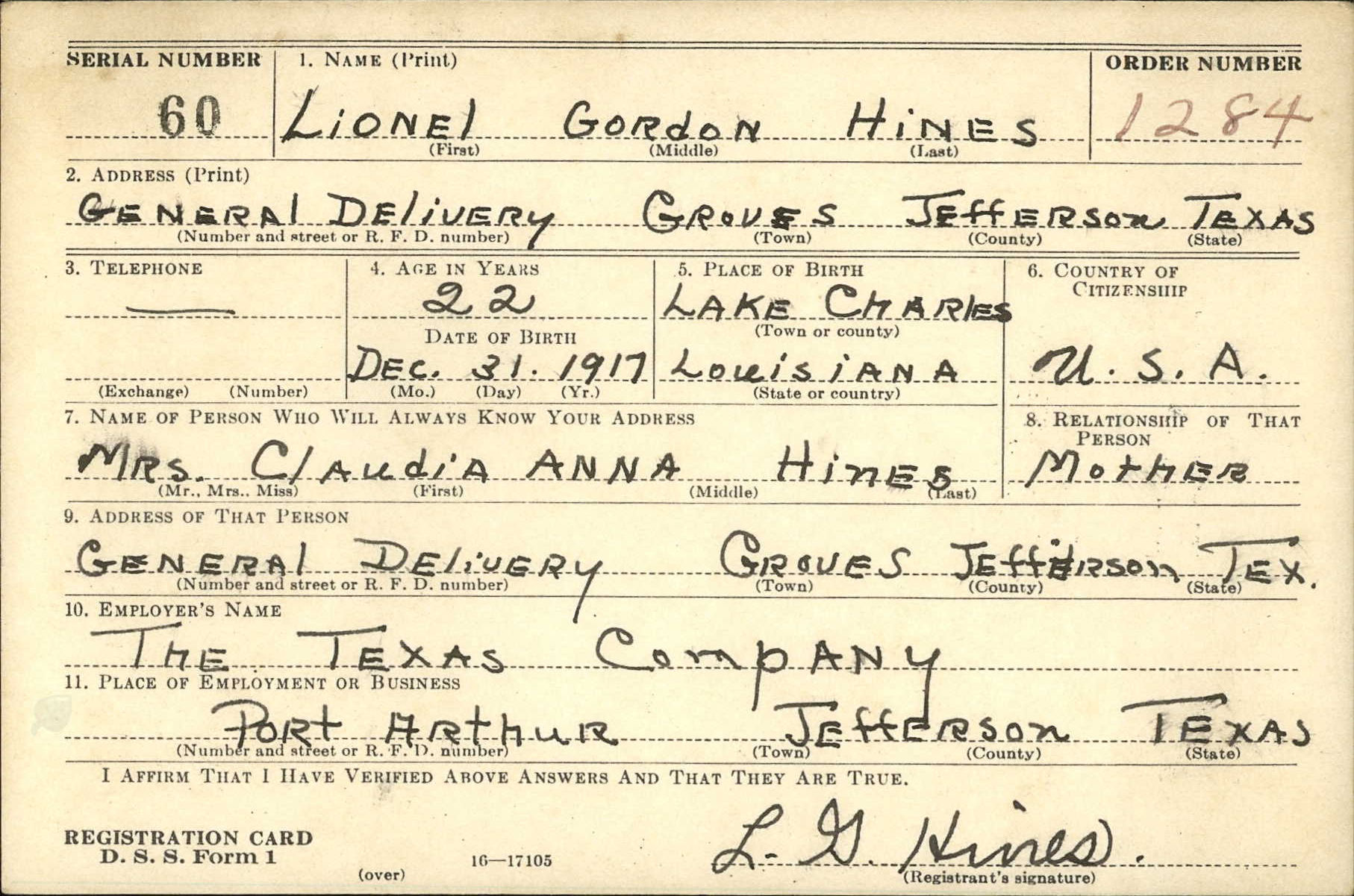
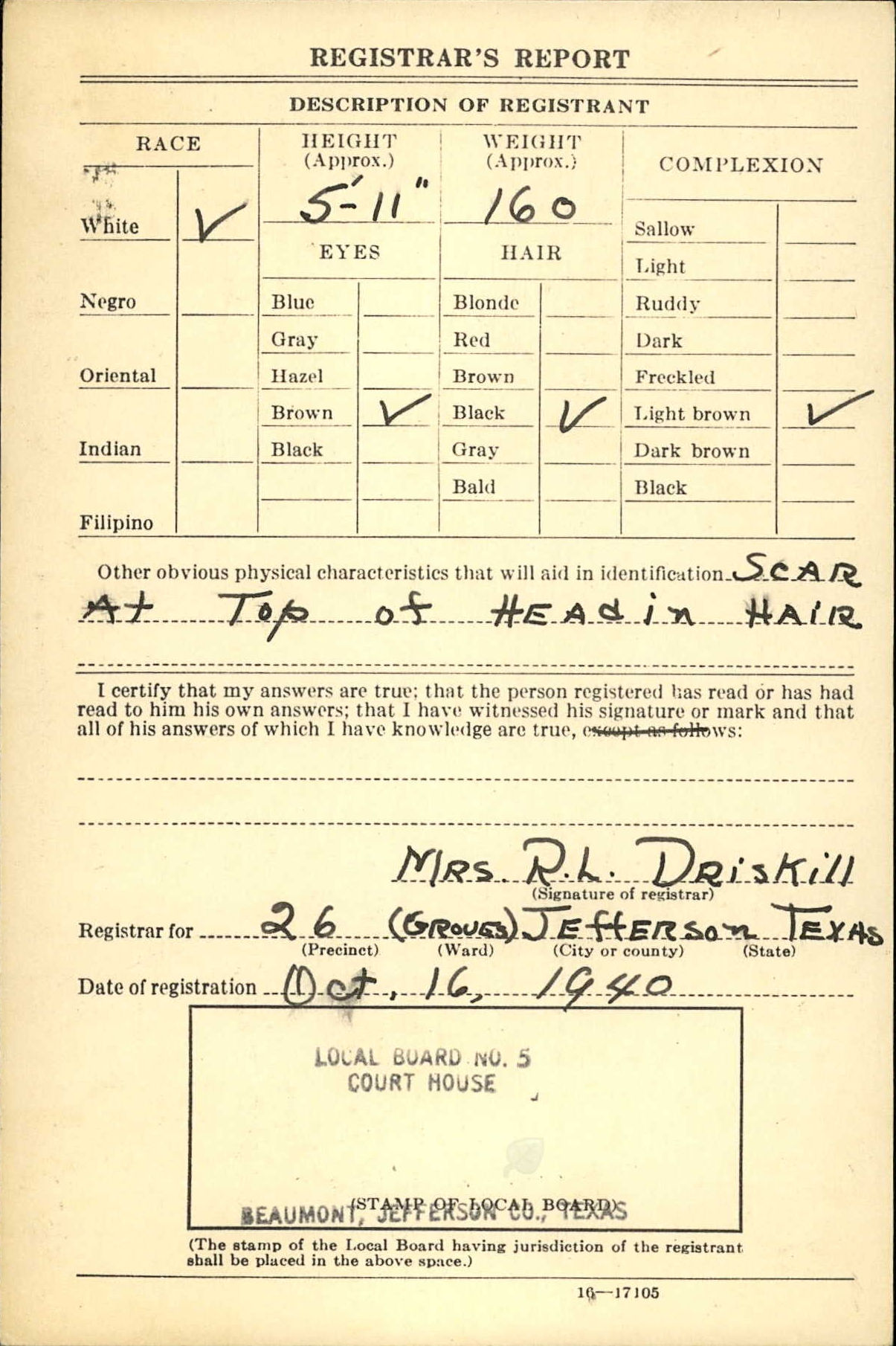
She found what she needed to find. Someone remembered knowing Lionel Gordon Hines. He was the kind of man who shared beers with his friends. He was the kind of man who signed his letters “I Will Always Love You.” He was her father. Kathy
Brister is an editor for the Atlanta Journal-Constitution.
It has always been difficult for me to determine which memories of my father are of actual events and which are my own thoughts and dreams that have become reality for me.
Do I remember seeing my dad very briefly when I was a toddler? Or is this memory one I’ve constructed, adding bits and pieces here and there to make the story feel real to me? The memory is a bit unnerving because I can sense the fear I felt when the stranger grabbed my mother and swung her around and then came to pull me from the closet where I had used the heels of my bare feet to push myself as far back as possible into the corner. Do I really remember the tall man who was standing in the yard under a tree talking with lots of people I didn’t know.
Those are the brief memories of the father I never knew because when he left that time to return to World War II, he boarded the ill-fated USS Indianapolis. On July 30, 1945, the ship was en route to the Philippines when it was attacked by a Japanese submarine and sank, taking with it my father, Lionel Gordon Hines, and the fathers, brothers, and sons of men and women my mother and I would never know.
My next memory involving my father was the day my mother went to answer a knock on the door with me following along. She opened the door and saw two men standing there. She must have known they were there to deliver the worst news possible. She seemed to become weak, and I thought she was falling when one of the men reached to help her. He presented her with a letter.
When the men turned and walked away, she went to the kitchen and sat at the table. I stood beside her as she cried and read the official notice that her husband and my father had been lost at sea. I still think how lonely and sad it must have been for my mother with no one there to comfort her except a small child who could not comprehend the magnitude of the loss that would affect us the rest of our lives.
As I grew and began going places with other families or spending the night at a friends’ houses, I felt loneliness, and perhaps even jealousy, as I saw the bond between father and daughter. I missed the father I never knew. I learned what I could about him. I listened to my grandmother and grandfather as they talked of their son. I was fortunate that my father’s brothers and sisters kept him alive by telling me stories of his childhood. I remember my grandmother’s dream, which she shared with me often: My father was injured and no one had been able to contact his family. In another frequent dream, her son was driven up to her house in a taxi and got out on crutches to climb the steps to the porch. My mother did not talk with me about my father except to say that he had told her on his last visit home that he would not make it back.
Even though many years have passed, I still can feel the emotions of the child - that empty, hurting place in the heart. When I hear now of families who have lost loved ones killed fighting for the United States, I especially think of the children. If they never come to know anything else about the parent they’ve lost, I want them to know that their loved ones were brave people who served their country well.
Daughter: Judy Brister



 ABBOTT, George Stanley
  FRONTINO, Vincent Fred
  AMICK, Homer Irwin