USS Indianapolis CA-35
Lost At Sea

Matt A. KLUCARIC
Name: Matt A. KLUCARIC
Rank / Rating: QM3-Quartermaster Third Class
Service #: 854 53 82
DOB: May 21, 1925
From: Chicago, IL
Parents: Mr. and Mrs. Matt Klucaric
Went Aboard: April 27, 1944
Age When Kamikaze Struck: 19 years, 10 months, 10 days
Spouse:
Children:
Grandchildren:
Bio Submitted By: Marilyn Northcutt Henry and Carl Fahnestock
Date Posted: May 08, 2026

Lost at Sea Matt A. KLUCARIC
Photo(s) Needed
Front of Draft Card for LAS Matt A. KLUCARIC
Back of Draft Card for LAS Matt A. KLUCARIC
During the battle of Okinawa, a Japanese Kamikaze plane made Indianapolis his target in the early morning hours of March 31, 1945. Overall damage to the ship was not severe but the attack took the lives of nine crewmembers, including Matt Anthony Klucaric. Matt was born May 21, 1925, in Chicago, IL, to Mr. and Mrs. Matt Klucaric, both born in Italy. He appears on the 1940 census as "Mathew", 14 years old, a student and had completed the 8th grade. Also in the home is his sister, Ann, 16 years old. The family was living at the same location on April 1, 1935.
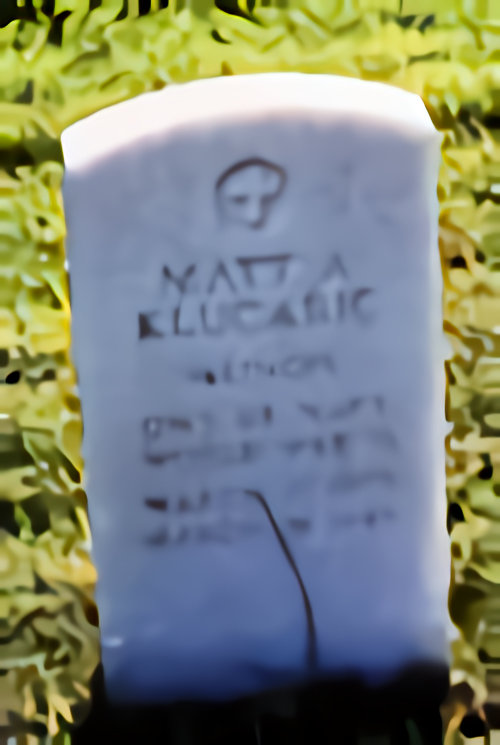
Matt registered for the draft on his 18th birthday. His mother signed as the one who would always know Matt's address. Matt enlisted in the USNR on September 16, 1943 in Chicago, IL. He arrived for basic training at the US Navy Training Center, Farragut, ID on September 26th. At arrival he was an Apprentice Seaman but showed great potential for further specialty training. Matt was advanced to S2c (Seaman 2nd class) on November 20, 1943 and received an additional 16 weeks of advance training. It is assumed this was Quartermaster preparatory training that would have included spherical trigonometry, geometry, and the physics of light and sound for signaling. On April 5, 1944, his rate was advanced to S1c (QM) (Seaman 1st class - Quartermaster). (QM) indicated he had completed specialty training as a Quartermaster. However, he would continue with the rate of S1c and complete his Quartermaster training "on the job", also known as "striking" for the rate. Matt was transferred to the receiving barracks at Shoemaker, CA on April 12, 1944. After seven months in the Navy, on April 26, 1944, he received orders to report to his first assignment. Also, this would be his first time on board a ship. On April 21, 1944, USS Indianapolis had arrived at San Francisco for overhaul following four months in the Pacific theater. She would remain in port only eight days before returning to the fray. Four days before departure, Matt saw his ship for the first time and his thoughts were likely those of other sailors when they first saw her. She was huge, magnificent, beautiful, sleek and stately. Everyone knew her name and now he would be part of the crew of this famed flagship of the 5th Fleet. He walked the gangway on April 27th and was granted permission to come aboard Indianapolis. Indianapolis departed San Francisco May 1, 1944 en route to Pearl Harbor. Matt had little time to settle in to shipboard life and there was organized chaos on board. Indy was providing transportation for 482 enlisted men and officers to Pearl Harbor. No doubt Matt was not allowed to move about the ship as he normally would have been. The decks were littered with men. Thankfully, the weather was good so the ship arrived on May 5th. Indy remained at Pearl Harbor until the 26th and Matt was likely granted shore leave. There were so many places to visit and sights to see, yet so little time. He knew he was headed soon for the war zone. When Indy returned to the Pacific, the Central Pacific Force in which she formerly served was now designated the Pacific 5th Fleet and continued under the command of now Admiral Raymond Spruance. Indianapolis continued as his flagship of the fleet. The war zone was a period of brutal service for Matt. From June to Oct 14, 1944, Indy took part in the capture and occupation of Saipan, Battle of the Philippine Sea, the capture and occupation of Guam, the capture and occupation of Tinian in the Northern Marianas Islands and on to the Western Caroline Islands operation for the capture and occupation of southern Palau Islands. Indy arrived back at Mare Island, CA on Oct 19, 1944 where she would undergo overhaul and a major refitting following her long Pacific service. On Nov 11, 1944, Captain Charles Butler McVay, III, assumed command of Indianapolis. Matt would spend Christmas and the beginning of the new year on dry ground and likely was granted leave during this time. New Year's day was a great day for Matt. After eight months of training, testing, and demonstrating his abilities, he was advanced to QM3c (Quartermaster 3rd class) on January 1, 1945. He would continue in the Seaman's branch on board ship, but would now wear a rating badge on his upper right sleeve that consisted of an eagle at the top, a ship's wheel in the center and one chevron below which indicated 3rd class. The official description of the quartermaster role included standing watch as assistants to officers of the deck and the navigator, serving as helmsman and performing ship control, navigation and bridge watch duties. When on duty, Matt could be found either on the navigation bridge or in the chart house, just off the bridge. Also, they procured, corrected, used, and stowed navigational publications and oceanographic charts and maintained navigational instruments and kept correct navigational time. In the event radio transmission was lost, quartermasters were responsible for emergency signaling to the rest of the fleet sending messages via flag hoist or flashing signal lamps. During General Quarters, quartermaster's recorded the action of the bridge writing minute-by-minute logs of engine orders, course changes, exact time of shells fired and hit or misses, just to name a few. They used the pelorus to notify the Captain of the relative bearing of incoming kamikaze or other ships to aid him in maneuvering the ship. After any battle action, quartermasters typed their handwritten notes for inclusion in the final official War Diary of the ship. Also, they aided in assessing any navigational damage. With her repairs and refit completed, Indy conducted numerous short trials between Mare Island, San Francisco and San Diego. She departed Mare Island on Jan 3, 1945 for San Francisco, then San Diego and forward to Pearl Harbor. On Jan 20th, Adm. Spruance came back aboard. Indianapolis arrived at Ulithi Lagoon on Jan 26, 1945 and would remain until Jan 31st. She joined Vice Adm. Mitscher's fast carrier task force on Feb 14th, two days before it made its first attack on Tokyo. Throughout the action, Indianapolis played her vital role of support ship. She sailed on to Iwo Jima where action began on Feb 19th. Indianapolis did her share of the bombardment of the island where Japanese soldiers hid in and attacked US forces from subterranean tunnels. She moved back to Tokyo to Honshu and Nansei Shoto for more bombardment of the islands and remained until the operation ended on March 1st. She returned to Ulithi Lagoon. On March 14, Indy was underway to joinTask Group 58.3. Anti-aircraft target practices were conducted during the day. Simulated coordinated air strikes on the Task Group were conducted the following day. Additional exercises were conducted during the following days as the Task Group proceeded toward Okinawa, but it was not clear sailing. Matt had a clear view from the bridge as Indy fired on an unidentified plane on the morning of March 18th. That afternoon more planes closed the formation. The Task Group Commander ordered radical emergency turns at speed of 25 knots. Indy opened fire on a "Frances" bomber when it approached the center of the disposition, flying at medium altitude and low speed. No kill was determined. "There was no rest at this time, however, as two enemy planes were reported closing the disposition...", according to the War Diary. Indy's guns again opened fire on a enemy "Judy" bomber as she approached close aboard to port headed directly at USS Bunker Hill. The planes dropped its bombs but missed Bunker Hill and then crashed into the sea. On March 19th, "Enemy aircraft were in the vicinity continuously." Two attack were made on Indy's Task Group. Indy opened fire on a "Zeke" and it was seen falling with a friendly fighter on its tail. Two minutes later Indy fired on an unknown enemy plane that was picked up only one minute before. Her 5-inch shells blew off the tail of the plane. Fifty-eight minutes later Indy opened her guns after spotting a "Judy" bomber diving on USS Essex. It was believed she assisted in the kill. Only thirteen minutes would pass before she trained her guns on another "Judy" that appeared almost directly overhead. The plane was later reported shot down but the crew did not see it fall. This was the last attack of the day. Matt surely was thankful to have escaped injury from his high perch on the ship which made him so vulnerable to the attacks. He had survived another day of the war. But, there were more to come. The pre-invasion bombardment of Okinawa began March 24th and for 7 days Indianapolis trained her 8-inch guns and bombarded beach defenses. Enemy aircraft filled the sky attacking the ships. Indy shot down six planes and assisted in splashing two others. It was on the 7th day, March 31st, at 0708 that Indianapolis became a target and was hit by a Japanese kamikaze plane. The attack was so sudden that there was little time to react. Eight of Indy's 20-millimeter guns could manage only about 50 rounds each, but it was enough to cause the plane to swerve and strike a glancing blow to the port side of the after main deck causing little overall damage. However, when the plane was only about 50 yards from crashing, the bomb carried on the plane's wing released, plummeted through the ship and exploded in the water beneath the hull. One of the crew's mess halls, a berthing compartment below it and fuel tanks were severely damaged as the bomb passed through and the explosion created two huge holes in the hull causing flooding of some compartments. Damage control teams quickly dogged down the hatches to the compartments to prevent further flooding of the ship. The emergency procedure sealed some survivors in a watery grave. There was no other choice if Indy was to be saved from massive flooding and possibly more injuries and deaths. Matt Anthony Klucaric, QM3c died as a result of the attack, as did eight of his shipmates. Three of the other men killed were rated QM3c. It can only be assumed that Matt and his fellow Quartermasters were not on duty on that early morning and were either in their berthing area or the mess hall. Matt's body was recovered, along with five of his shipmates, and on April 1, 1945, Easter Sunday, six flag-draped wooden coffins were placed in a row on the quarterdeck of Indianapolis. At 1600 hours a funeral service with full military honors was performed by the ship's chaplain, Father Thomas Conway. After the service, Matt's coffin was carried from Indianapolis by his shipmates for burial in the US Armed Forces Cemetery located on Zamami Shima, Kerama Retto, off the island of Okinawa. Matt was awarded the Asiatic-Pacific ribbon with 1 silver star, equaling 5 bronze star devices, for the five stars awarded to Indianapolis while he served on board. He was awarded the Purple Heart posthumously. Matt, you are not forgotten. After the war, families were given the opportunity to request that the remains of their loved one be returned to the US for reinterment. Exactly four years from the date of his burial on Zamami Shima, on April 1, 1949, Matt was reinterred in Camp Butler National Cemetery, Springfield, Sangamon County, IL, Section C, Grave #331. Learn more about the kamikaze attack and the nine nine men who died.

Source Credits
1940 US Census, IL, Chicago, Cook Co., HH# 6010, South Justice Street; citing family of "Matt Kljucaric". Navy Department, Casualty Section, Office of Public Information (1946): Combat Connected Naval Casualties, WWII, by States; Vol. AL-MO; IL, p. 25; citing Matt A. Klucaric son of Mr and Mrs Matt A. Klucaric, Marshfield Ave, Chicago. USN training station rolls, deck logs and war diaries. Online at Ancestry.com and NARA.gov. USN WWII Muster Rolls, 1938-1949; Ancestry database US Government, Department of Veterans Affairs, Application for Memorial Grave Marker; citing Matt A. Klucaric. Ancestry.com. U.S., National Cemetery Interment Control Forms, 1928-1962 [database on-line]. Lehi, UT, USA: Ancestry.com Operations, Inc., 2012. Original data: Interment Control Forms, 1928-1962. Interment Control Forms, A1 2110-B. NAID: 5833879. Record Group 92, Records of the Office of the Quartermaster General, 1774-1985. The National Archives at St. Louis, St. Louis, MO; citing reinterment April 1, 1949.
Submit additional information, photos, or corrections for Matt KLUCARIC.
Photos / Clippings / Other