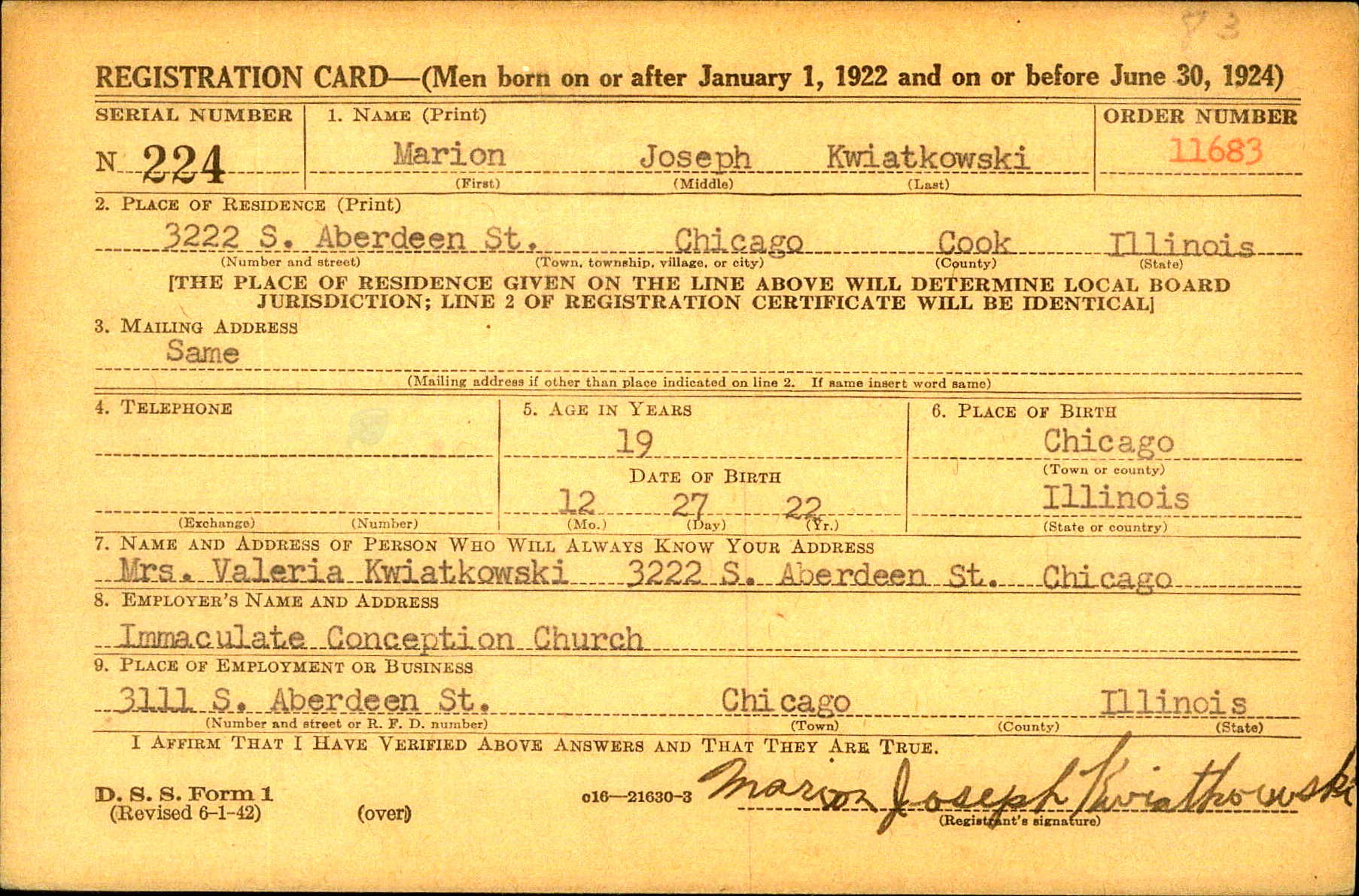
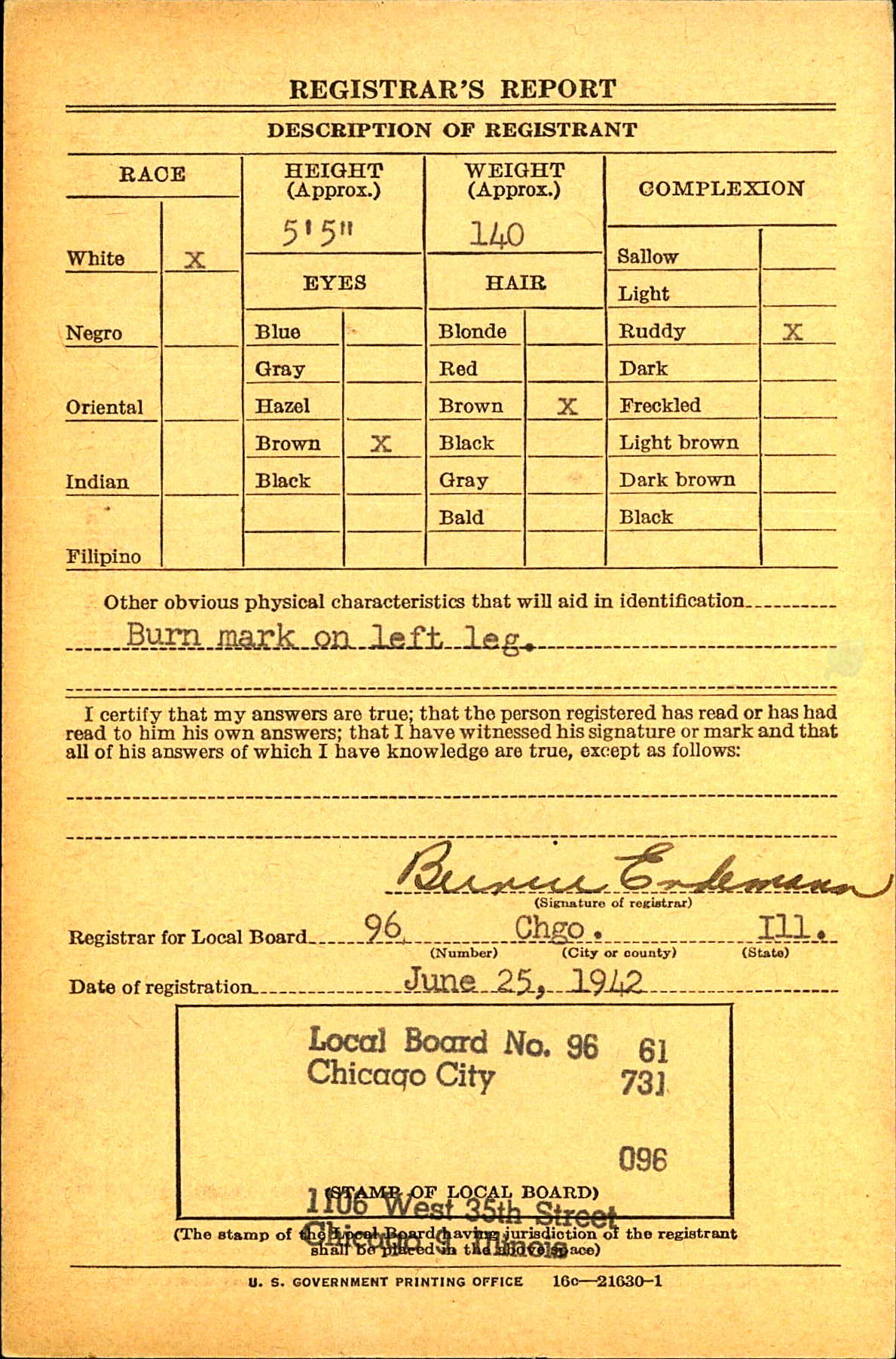
He registered for the draft in Chicago at age 19 on June 25, 1942. He was still living on South Aberdeen Street and had found work a short distance from his home at the Immaculate Conception Church on South Aberdeen Street in Chicago.
Whether Marion enlisted or was drafted into the Navy is not known. He is noted as enlisting on June 1, 1943 at Chicago and was received the same day at Great Lakes Naval Training Center for bootcamp. He advanced from AS (Apprentice Seaman) to S2c (Seaman 2nd class) on July 24, 1943. From Great Lakes, on Aug 3rd he was transferred to the Personnel Distribution Center in Pleasanton, CA, for forwarding for duty. Pleasanton is referred to in later naval records as the Naval Training & Distribution Center (TADCEN) at Camp Shoemaker, CA.
The train ride from Illinois to California was long, slow and crowded since this was main transportation used by the Navy to move its sailors within the US. Three days later he arrived in Pleasanton, located near Dublin, CA.
Marion saw his new ship at Mare Island, Vallejo, CA, on Sept 1, 1943. USS Indianapolis CA-35 had arrived the day before for overhaul following four months of service in the Pacific. The heavy cruiser loomed large among the ships at dock. Some crewmembers believed she was the most beautiful ship they had ever seen. As he walked the gangway, Marion wondered how he would ever find his way around a ship that was two footballs fields long.
The first week of Sept many crewmembers were transferred off and Marion was one of 137 new crewmembers who reported aboard. Like Marion, most had never been to sea. That was about to change.
Indianapolis sailed for Pearl Harbor on Sept 7th. Passing under the Golden Gate Bridge for the first time was something Marion would never forget. He was likely assigned to the deck crew with duties that involved routine ship cleaning and maintenance, line handling and standing watch as he learned shipboard life. He likely developed his "sea legs" during the four days it took Indy to reach Pearl Harbor.
Indy would remain there and conduct training exercises at sea until early November. A well trained and disciplined crew would be needed when she received orders to return to the war zone. Even with the demanding training, there would be time for brief shore leaves where Marion could enjoy all the harbor had to offer.
On Nov 5, 1943, Marion would have his first experience on board a flag ship when Vice Admiral, later Admiral, Raymond A. Spruance came aboard Indianapolis as Commander of the Central Pacific Force. Being on board a flag ship was considered a privilege and an honor. There was an added benefit that a flag ship avoiding putting herself directly in harm's way, if possible, to protect the Commander.
Indianapolis departed Pearl Harbor on Nov 10, 1943, steaming to the Gilbert Islands for "Operation Galvanic" against Tarawa and Makin Islands. The war was becoming a reality for Marion. On Nov 19, 1943, Indy, in a force of cruisers, bombarded Tarawa and the next day pounded Makin. This was not a training exercise. Marion realized the difference and knew he was now fighting the enemy. The ship's triple 8" guns caused the deck beneath Marion's feet to heave with every blast as the smoke filled the main deck. The sound was deafening as all the cruiser's fired and he witnessed the shells tearing into their targets and debris erupting into the air. He would likely never forget his first time in battle action.
Indianapolis returned to Tarawa and acted as a fire-support ship for the landings. Marion witnessed the ship's 5" anti-aircraft guns zero in on and splash an enemy plane. For the next three days, the ship' 8" guns shelled enemy strong points as valiant landing parties struggled against fanatical Japanese defenders in an extremely bloody and costly battle. [DANFS]
She returned briefly to Pearl Harbor on Dec 11, 1943, en route to the west coast. 366 enlisted crewmembers disembarked to remain at Pearl until Indy's return from CA. Marion was one of the lucky men who were assigned to the Commander at Pearl Harbor for temporary duty. He would spend Christmas and New Year's Day under the warm sun and blue skies of Hawaii.
Indy departed Mare Island on New Year's Day for San Francisco. She stayed only long enough to embark officers and passengers for transport to Pearl Harbor where she arrived on Jan 7th. Marion and his shipmates who had remained at Pearl came back aboard as the ship prepared to return to the war action.
She departed the harbor bound for the Marshall Islands to aid in the actions against Kwajalein and Majuro Atolls in late January. Indy's service ended in the Marshalls after supporting the occupation at Eniwetok.
Steaming to the Western Carolinas, Indy took part in the raids on Palau, Yap, Ulithi and Woleai. On April 10th she left Majuro for Pearl Harbor and on April 22nd she arrived back in San Francisco, CA. Marion was not likely granted furlough because Indy would be in port only eight days before steaming back to Pearl Harbor on May 1st.
When Indy returned to the Pacific in early June, the Central Pacific Force in which she formerly served was now designated the Pacific 5th Fleet and continued under the command of now Admiral Spruance, on board Indianapolis.
This would be a period of brutal service for Marion. From June to Sept 29, 1944, Indy took part in the capture and occupation of Saipan, Battle of the Philippine Sea, the capture and occupation of Guam, the capture and occupation of Tinian in the Northern Marianas Islands and on to the Western Caroline Islands operation for the capture and occupation of southern Palau Islands.
Marion arrived back at Mare Island, CA on Oct 19, 1944 where Indy underwent overhaul and a major refitting following her long Pacific service. In addition, new paint would be applied to the inside and the proud ship would be given a facelift - new camouflage. Her measure 32/7D pattern dazzle camouflage, applied six months earlier, was replaced with measure 22. For the work to be completed, most of the crew was removed from the ship. The single enlisted men moved to the barracks at the Navy Yard. It is not known with certainty if Marion was granted leave to visit his family, but it is very possible.
On Nov 11, 1944, Captain Charles Butler McVay, III, assumed command of Indianapolis. He was well liked by the crew.
A good life in port continued for Marion and he would spend Christmas and the beginning of the new year on dry ground enjoying his free time in Vallejo and nearby San Francisco.
With repairs and new paint completed, it was time for Marion to return to the reality of the war. Indy conducted numerous short trials between Mare Island, San Francisco and San Diego. She departed Mare Island on Jan 3, 1945 for San Francisco, then San Diego and forward to Pearl Harbor. On Jan 20th, Adm. Spruance came back aboard.
Marion arrived with his ship on Feb 1, 1945 at Ulithi Atoll, two weeks before she made her first attack on Tokyo on Feb 15th. Throughout the action, Indianapolis played her vital role of support ship. She sailed on to Iwo Jima where action began on the 19th and she did her share of the bombardment of the island where Japanese soldiers hid in and attacked US forces from subterranean tunnels. She moved back to Tokyo to Honshu and Nansei Shoto for more bombardment of the islands and remained until the operation ended on Mar 1st.
The pre-invasion bombardment of Okinawa began Mar 24th and for 7 days Indianapolis bombarded beach defenses. Enemy aircraft filled the sky attacking the ships. Indy shot down six planes and assisted in splashing two others in what would become the "Great Marianas Turkey Shoot." This was an experience and event that Marion would long remember and relive with his family and friends.
On March 31st, the day before the invasion, the ship was hit by a Japanese kamikaze plane. Nine men were killed and 20 injured. There is no record that Marion was injured. After temporary repairs at Guam, Indy limped back to Mare Island, CA, for repairs. She arrived May 2nd and would remain there for two-and-a-half months. Most assuredly, Marion was granted leave to visit his family.
On July 12, 1945, with work not yet completed, Capt. McVay received an unexpected order to have Indy ready to depart the US no later than July 16th. Telegrams were sent ordering crewmembers and officers to return to the ship immediately. All leave and service school training was cancelled.
He was to depart Mare Island that day for Hunter's Point Navy Yard in San Francisco Bay where he would receive top-secret cargo for transport to the island of Tinian in the Northern Mariana Islands. Two Navy officers would come aboard with the cargo to ensure its safe delivery. He was to proceed at flank speed to Pearl Harbor, refuel and continue on.
McVay was not told the contents of his cargo, so no one else on board knew. Rumors were rampant among the enlisted.
In the early morning hours of July 16, 1945, Indy prepared to get underway. She depart Hunter's Point at 8:00 a.m., and at 8:36 a.m., passed under the Golden Gate Bridge. Later in the day of July 16th, McVay was told by one of the Navy officers in charge of the top-secret cargo that "every day we take off the trip is a day off the war." McVay informed only key officers what he had been told. They kept their thoughts to themselves. Officers never started rumors.
The first day at sea was miserable for the crew. Indy hit rough seas with swells of fifteen feet. Even with a slight reduction in speed, with each wave the ship rose then suddenly slammed into the troughs with a violent jarring along with a roll from side-to-side. The next day the weather improved and the ship increased her speed to near flank.
Arriving at Pearl Harbor, Marion would long for just a few hours on dry land. It was not to be. No one was allowed to go ashore except those with previous orders. But, there was good news. Indy had steamed, averaging 29.5 knots, over 2,000 nautical miles in 74.5 hours from the Farallon lightship at San Francisco to Diamond Head, Oahu, TH, setting a new time record. The crew erupted with shouts and cheers when Capt McVay announced Indy's speed record. Indy refueled and continued her mission.
Her trip was uneventful and she offloaded her secret cargo at Tinian on July 26th. Before departing that afternoon, McVay received orders to proceed to Guam, 120 miles south of Tinian. The next morning she arrived at Apra Habor, Guam, where McVay received routing orders for her final destination - Leyte.
Indy departed Apra Harbor the next morning, Sunday, at 9:00 a.m. Half-way en route to Leyte, on July 30, 1945, Indy was struck by two torpedoes from Japanese submarine I-58 and sank in 12 minutes. Whether Marion made it off the ship and into the water is not known.
Marion had served on board Indianapolis for one month shy of two years. He was not yet 23 years old when he gave all to his country.
Marion earned the Asiatic-Pacific ribbon with one silver star, representing 5 bronze stars, and 3 bronze stars to represent the 8 battle stars awarded to Indianapolis in the time he was on board.
His name is inscribed on the Tablets of the Missing in the Manila American Cemetery, Fort Bonifacio, Taguig, Philippines. He was awarded the Purple Heart, posthumously.
Marion, you are not forgotten.
Source CreditsAncestry.com. Cook County, Illinois Birth Index, 1916-1935 [database on-line]. Provo, UT, USA: Ancestry.com Operations Inc, 2008.
Original data: Cook County Clerk, comp. Cook County Clerk Genealogy Records. Cook County Clerk’s Office, Chicago, IL: Cook County Clerk, 2008; citing Marion Kwiatkowski b. 28 Dec 1922. File # 6056929. *This is a Index of records and date is likely a typographical error.
1940 US Census, IL, Cook Co., Chicago, Ward 11, Block 16. HH # 175; citing family of Anthony Kwiatkowski.
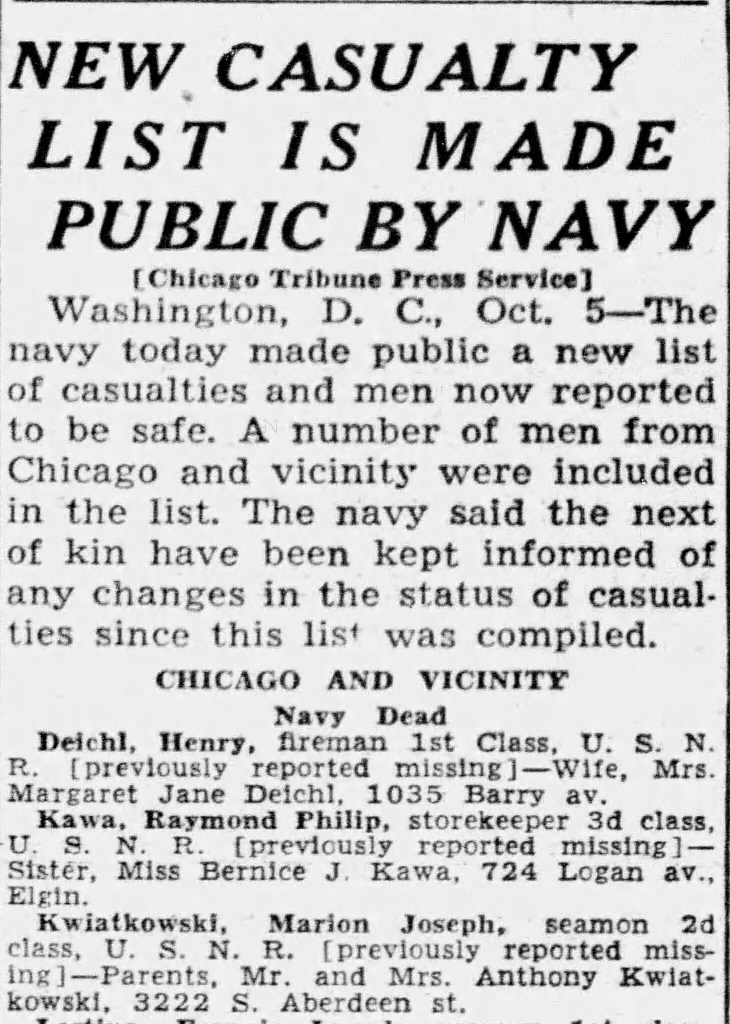
Chicago Tribune, Sat, Oct 6, 1945, p. 10; citing casualty list.
Navy Department, Casualty Section, Office of Public Information (1946): Combat Connected Naval Casualties, WWII, by States; Vol. AL-MO; IL, p. 26; citing parents Mr and Mrs Anthony Kwiatkowski, Chicago, IL.
USN WWII Muster Rolls, 1938-1949; Ancestry database
USN Ships, Stations and Other Naval Activities, 1939-1949; Ancestry database
USN USS Indianapolis CA-35 Final Sailing List, 17 Aug 1945; Ancestry database