Rank / Rating: PVT-Private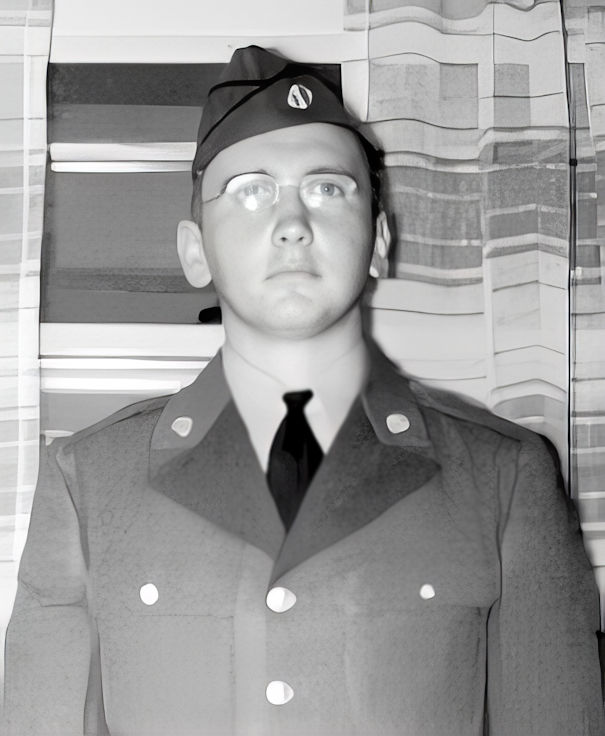
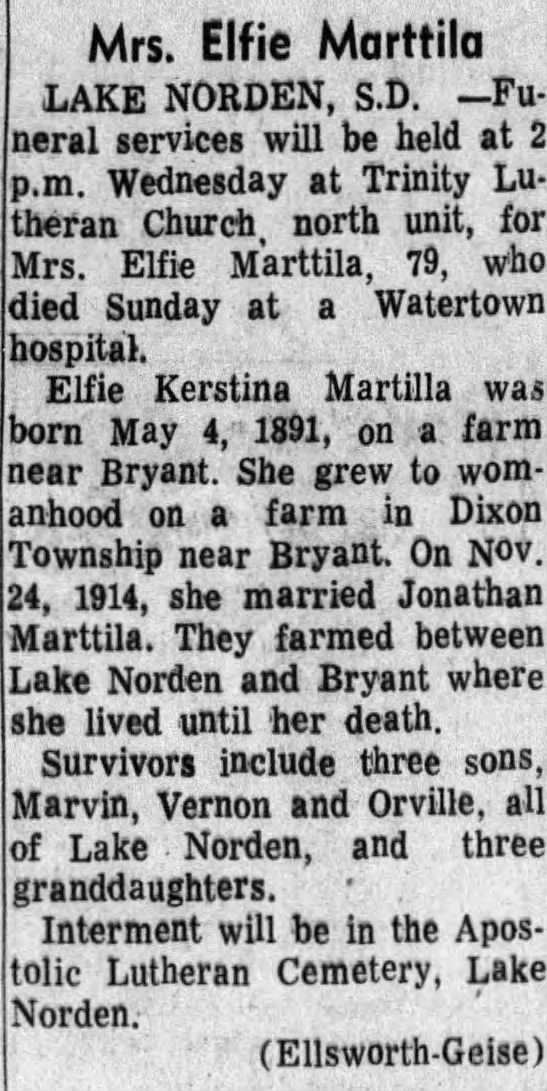
 By 1930, they had four sons. Pvt. Howard William Marttila was their youngest, born Dec 7, 1924. His brothers were Marvin Peter, Vernon Hamilton, and Orville Mathias.
Jonathan was a farmer and the family lived between Lake Norden and Bryant, where Elsie was born. Jonathan died May 30, 1939 when Howard was 14 years old.
The 1940 census shows Elsie with her sons in Hamlin Co., near Cleveland Township, SD, still living on the family farm. Her oldest son, Marvin and third son Orville were farmhands for their mother. Vernon was away attending college where he had already completed his second year. Howard was 15 years old, a student and had completed the 1st year of high school.
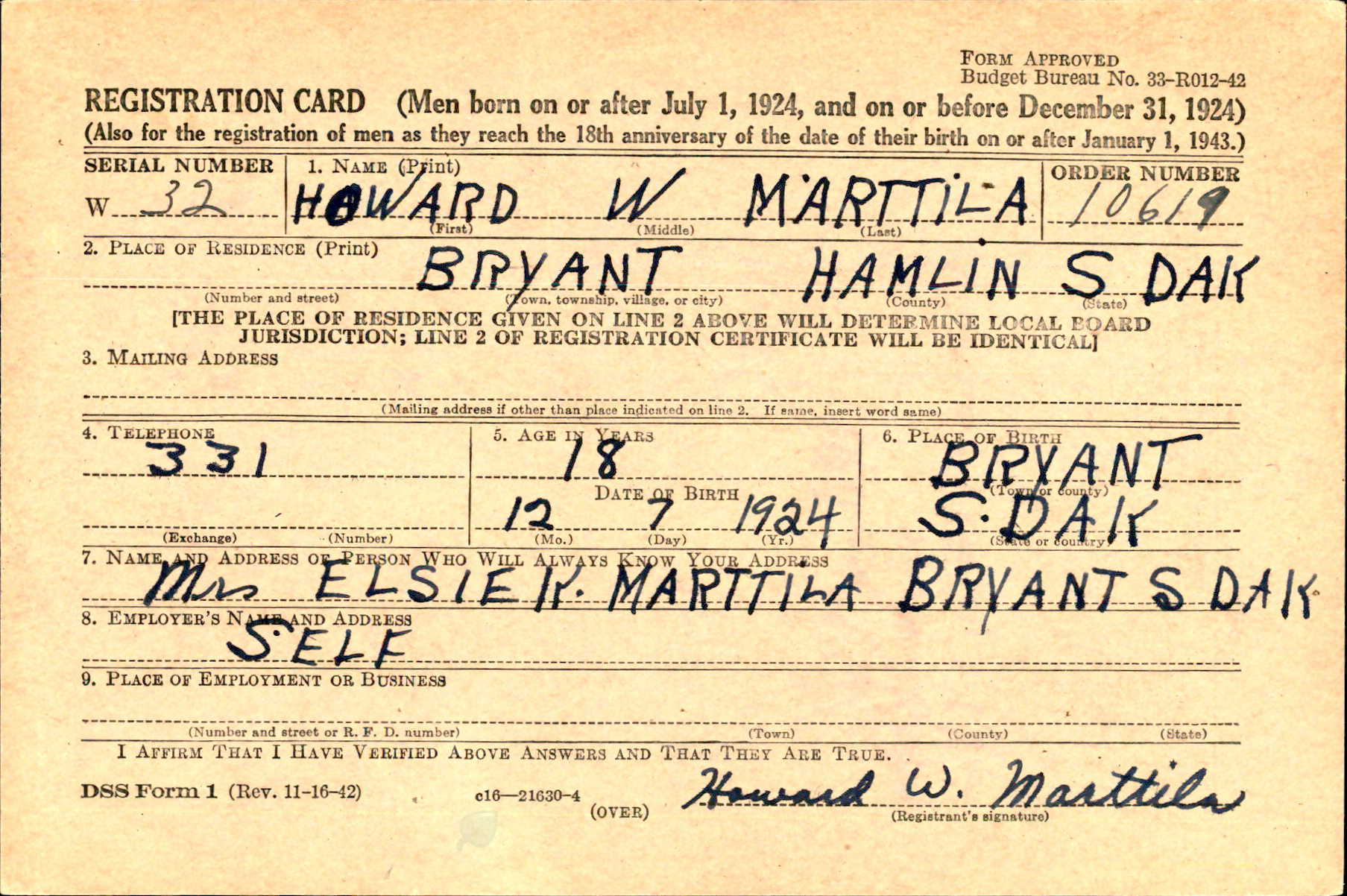
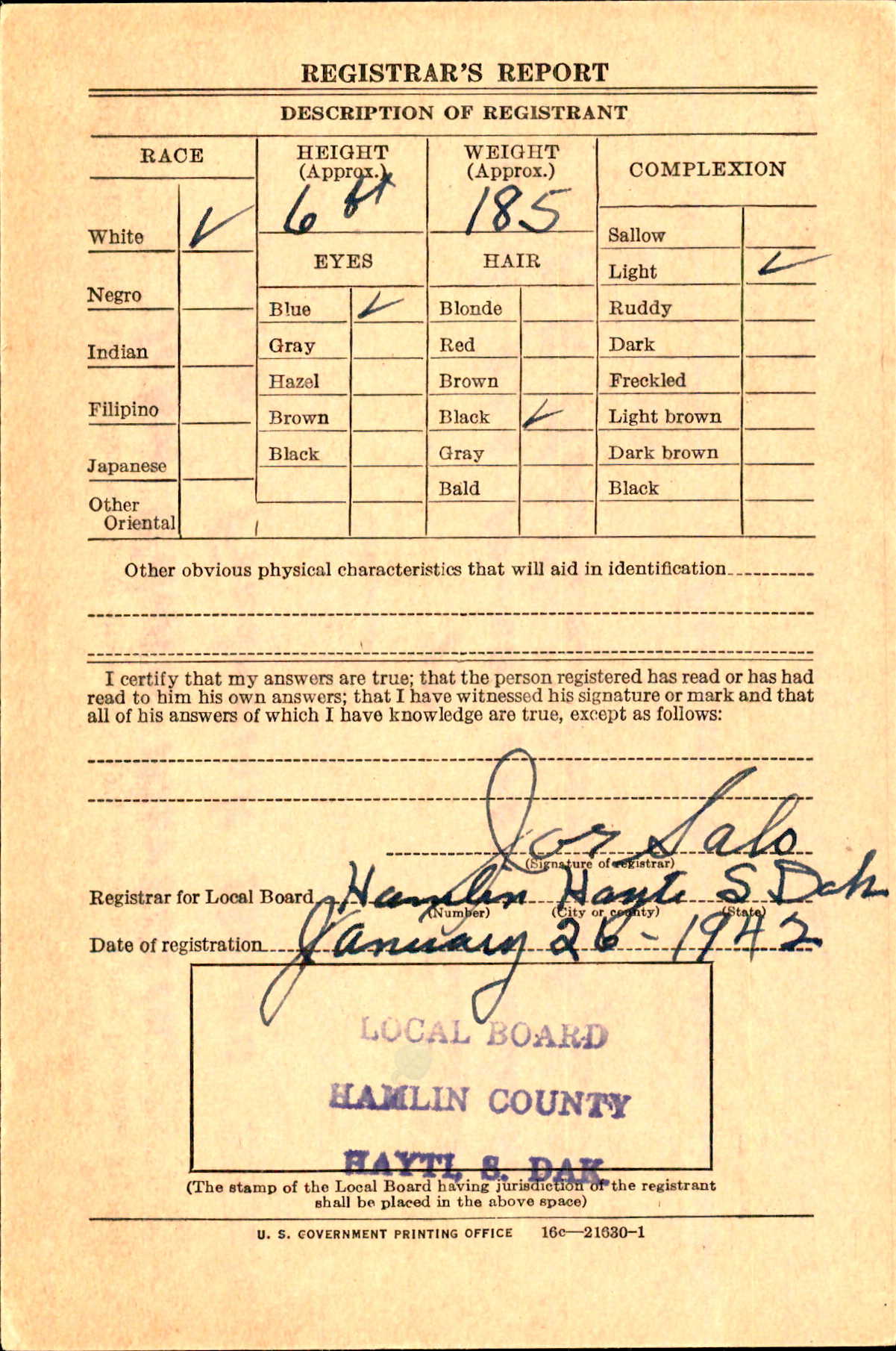
At age 18, Howard registered for the draft on Jan 26, 1942 in Hayti, Hamlin Co., SD. He completed high school that year and hoped he would not be drafted any time soon because he had another plan. He would follow in his brother's footsteps and attend college.
In the fall of 1942, Howard enrolled in South Dakota State College in the School of Engineering. His dream was to become an Electrical Engineer. After completing his first year, he received a letter from the President of the United States with orders to report to his local draft board.
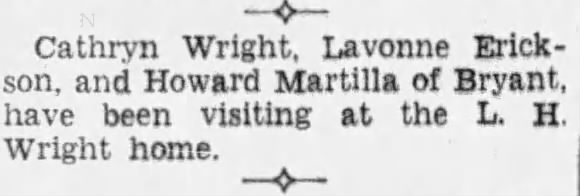
A brief announcement appeared in the Argus-Leader, (Sioux Falls) newspaper on Tues Nov 14, 1944, p. 4: "Howard Marttila of Lake Norden, SD, spent a few days at the L. A. Wright home, 2001 South Dakota Avenue. He will go to Hayti and Fort Snelling, MN, on Wednesday."
There is no doubt that the news article was describing Howard's induction into the armed service. Howard would report to his local service center in Hayti on Nov 15, 1944, where he had registered for the draft. From there he would be provided transportation to Fort Snelling, MN, which was a major induction center in 1944 and the closest one to rural Hayti. There, he was selected to serve in the US Marine Corps. Being very intelligent and with one year of college to his credit, he was an asset to the Marines.
Howard was immediately transferred to Parris Island, SC. On Nov 19th, he wrote a letter to his brother from Washington, DC., stating, "I am now a member of the U. S. Marine Corps" and that he would arrive at Parris Island the following day. Howard described his journey from MN to Washington saying he had been through WI, IL, IN, OH, PA, MD and VA. Also, he relived his train ride from SD. "I stood up for three hours going down to Fort Snelling."
At Parris Island, Howard would complete eight to twelve weeks of basic training. He would undergo intense physical training, weapons training and hand-to-hand combat techniques.
His next stop was at Camp Lejeune, NC. He was assigned to the Infantry Training Regiment where he would train for an additional four weeks. This advanced training involved additional rifle and marksman training, and instructions for the skills involved in beach landings.
Howard would not remain in the infantry. Through testing and based upon his performance, he qualified for Sea School on Jan 9, 1945. Sea School was a very sought after assignment by many Marines. It meant the chance to be part of an elite team aboard a capital ship - battleships, cruisers and aircraft carriers. This duty offered early promotions and travel to exotic ports. The best part was being issued the Marine Corps uniform that definitely would set him apart from the other branches of service. It was said that the Marine uniform turned the heads of ladies.
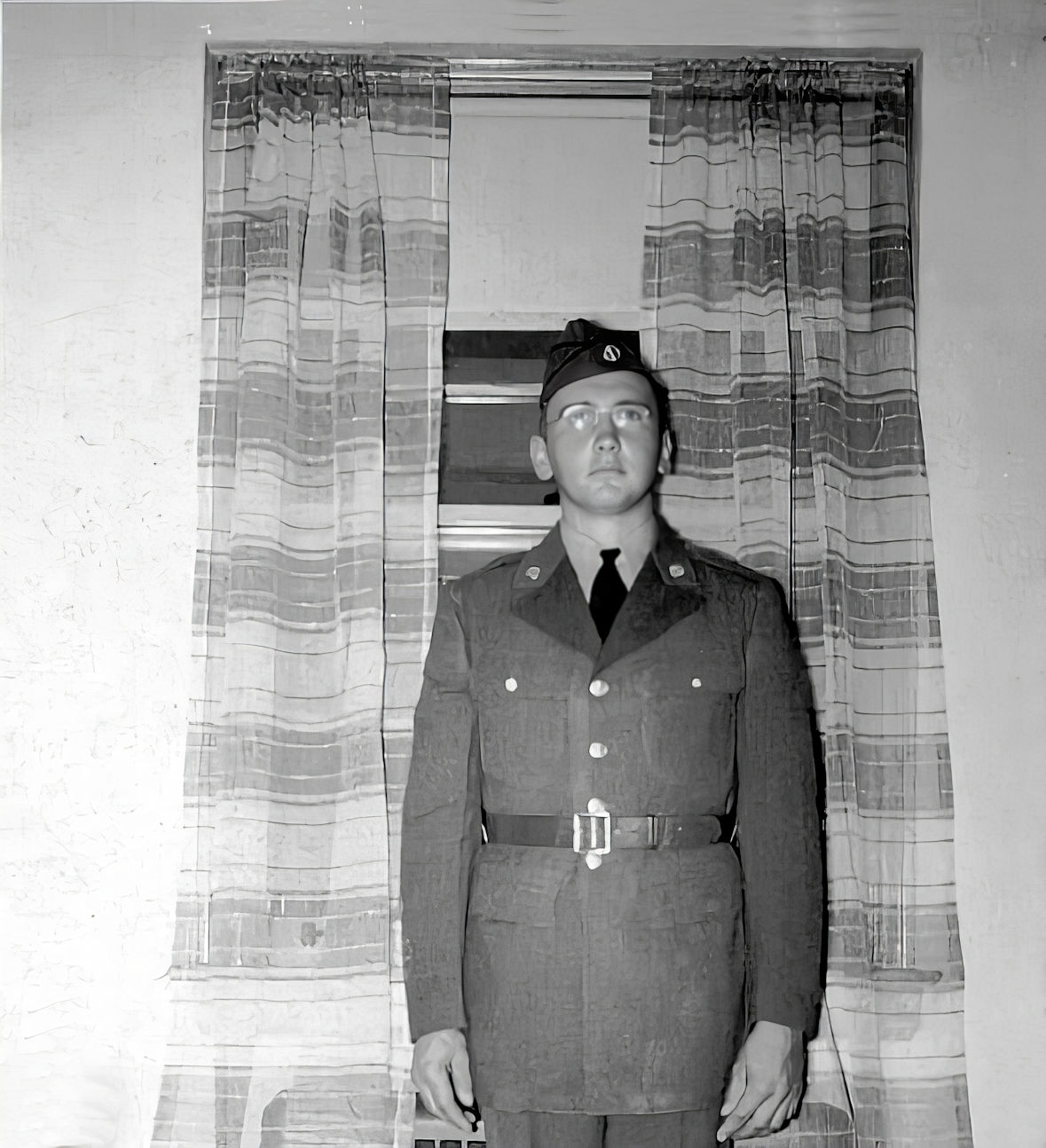
Howard was granted a 15-day leave after completing his training at Camp Lejeune and would return home to visit his family and friends. A photo taken during this time appears in the upper right of this biography and shows him wearing the Winter Service A, non-dress, medium ("Sage") green uniform issued to graduates at the time.
He was transferred to the Sea School in San Diego, CA, where he arrived on Apr 15, 1945. He would learn about life on board a Navy vessel, handling of small boats and special gunnery training. On a capital vessel the Marine unit manned one or more guns during General Quarters. Their other duties were to maintain the brig, or jail, on board and provide general security on board as well as around the ship when in port.
Wearing his tailored green uniform, Howard looked handsome and carried himself with great pride when he reported for his first duty assignment. On May 14, 1945, he went aboard USS Indianapolis CA-35 at Mare Island, Vallejo, CA, while the ship was in the yard for repairs following a kamikaze attack on March 31, 1945. The scuttlebutt was that the repairs would not be completed until late August. Howard would have some time to explore Vallejo and San Francisco where most Marines spent their time on shore leave. He was sure he would turn the heads of all the ladies as he strolled about in his new uniform.
Howard's life in port ended abruptly on July 12th, 1945 when Captain Charles B. McVay received an unexpected order to immediately prepare his crew for departure and he should depart no later than July 16th.
Indianapolis departed Mare Island on Sunday morning, July 15th, for a short trip to Hunter's Point Navy Yard at San Francisco. Later that afternoon, top-secret cargo was loaded on board for transport to Tinian in the Northern Mariana Islands. A large wooden box was hoisted on board and placed in the port hanger that normally housed one of the scouting aircraft. The box was strapped securely to the deck. In addition, a metal canister, about the size of an old-fashioned ice cream freezer, was brought aboard and placed in the flag lieutenant's cabin located in what was known as "officer's country." Enlisted men were not allowed to enter this part of the ship. Like the large crate, the canister was strapped and bolted to the deck.
Captain Edward L. Parke, USMC, had called his men to the deck where they were informed they would stand guard on the mystery cargo, never leaving it unattended. They were to consider the watch "live ammunition duty" meaning each man on watch would keep one round in the chamber of his pistol at all times. Each watch would be 4 hours on and 4 hours off. With such a small detachment of men this was brutal service and left little time for sleep. Being a Pvt. and new on board, It is likely that Howard stood guard on the wooden crate in the hanger. An area 30x30 feet away from the crate had been marked with red tape and Howard was to assure that no one stepped inside the cordoned off area. He could not have imagined this would be one of his duties on the ship, but like the true Marine he was he would follow orders and not ask questions. However, he did have a question. It was the exact one that all the crewmembers wanted answered. What was the cargo they were transporting? Even if they could have asked, there would be no answer. No one on board, not even Captain McVay, knew the contents of the cargo.
When Indy departed Hunter's Point the next morning, July 16, 1945, it was Howard's first real trip to sea. Captain McVay had been ordered to proceed at flank speed on the mission, and he did. He ordered the crew to stay clear of the forward part of the main deck because the speed of Indy could cause large waves to break over the bow.
A few hours later, Indy hit rough seas with swells of fifteen feet. Even with a slight reduction in speed, with each wave the ship rose then suddenly slammed into the troughs with a violent jarring along with a roll from side-to-side. The old salts on board had experienced a much worse ride, but Howard was not likely reassured by their calmness. Many men were seasick and were unable to leave their bunks the first few days. Howard later wrote a letter to his brother proudly stating, "my constitution must not be too bad" because he did not get seasick like the others.
Later in the day of July 16th, McVay was told by one of the Navy officers in charge of the top-secret cargo that "every day we take off the trip is a day off the war." McVay informed several key officers what he had been told. It only raised more questions in their minds about the mysterious cargo.
Arriving at Pearl Harbor, Howard would long for just a few hours on dry land. It was not to be. No one was allowed to go ashore. But, there was good news. Indy had steamed, averaging 29.5 knots, over 2,000 nautical miles in 74.5 hours from the Farallon lightship at San Francisco to Diamond Head, Oahu, TH, setting a new time record. The crew erupted with shouts and cheers when Captain McVay made the announcement.
Rumors were still rampant on board, but no one could have imagined that Indy was transporting the components of the atomic bomb that would later be dropped on Hiroshima. Indy steamed on toward Tinian without incident. The seas were calm and the weather beautiful. Life at sea was good.
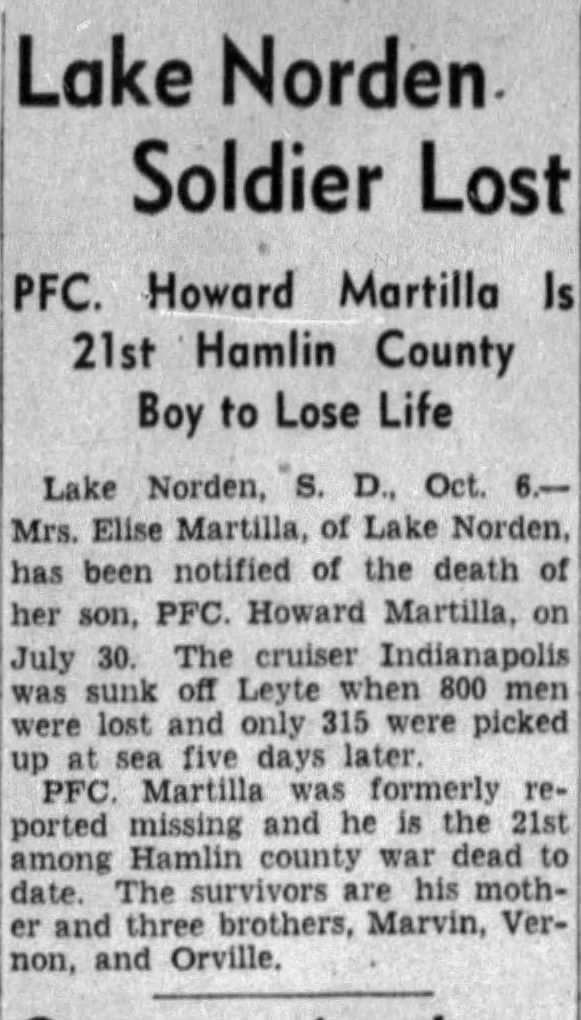
After the delivery of her cargo, Indianapolis departed Tinian and after a short stop at Apra Habor, Guam, she sailed for Leyte, her final destination. Half-way to Leyte, on July 30, 1945, Indy was struck by two torpedoes from Japanese submarine I-58 and sank in 12 minutes. Whether Howard made it off the ship and into the water is not known. There were 39 Marines on board and Howard was one of the 30 who were killed.
Howard was four months shy of his 21st birthday. He was a young man with a big dream that would never be realized. He planned to return to college when the war was over and complete his engineering degree. Death was never part of his plan.
Howard would never know that the mission of his first ship would be part of bringing an end to WWII. He was awarded the Purple Heart, posthumously. His name is inscribed on the Tablets of the Missing in the Manila American Cemetery, Fort Bonifacio, Taguig, Philippines.
Howard, you are not forgotten.
In addition to his Purple Heart, Howard was eligible for the WWII Victory medal. Also, his family may request the Combat Action ribbon which was approved in 1999 and made retroactive to Dec 7, 1941.
On Jan 30, 2001, the Navy approved a Navy Unit Commendation for the period July 16 to July 26, 1945. This is the second highest unit award awarded by the Navy.
In July 2020, the Congressional Gold Medal, the highest civilian award, was awarded to the crewmembers of Indianapolis.
Note: At the time of Howard's death, his mother was living in Lake Norden, SD. She died in 1970 and is buried beside her husband in Apostolic Cemetery, Lake Norden, Hamlin Co., SD.
Some official USN records list his "address" as Minnesota, but only because this is where he enlisted.
The following was submitted to this project in Jan 2026 by Joan Marttila, niece of Howard:
When my parents, Vernon and Lois Marttila were both deceased, I acquired a box containing letters my father sent to my mother during their courtship. Among the letters, I found several letters that United States Marine Corps Private Howard Marttila wrote to my parents after they had married and moved to Ames, Iowa. Howard and his brother, Vernon, an Army Reservist attending veterinary school at Iowa State College in Ames, Iowa, wrote faithfully to each other. Their correspondence began in November, 1944 as Howard makes his way to Parris Island. His last letter to Vernon was written from USS Indianapolis and is dated July 21, 1945.
Although the fate of USS Indianapolis was not often discussed during our childhood, my parents made sure that my two sisters and I knew its story. We knew that Howard was the youngest of four brothers and that their mother was widowed at an early age - leaving all of them to make a living on the family farm in South Dakota. We knew that Howard was enrolled as an engineering student at South Dakota State College. We did not know until much later that my father considered Howard the “smartest one” of the four boys.
My sisters and I have read Howard’s letters. They describe his current location, what he is doing and what he is thinking. The letters reveal a bright, honest and humorous young man who has an easy-going but firm way with people. In his letters, he includes math problems, jokes and funny sayings. He requests a dictionary because his vocabulary is going downhill. He describes how many young women seem to be attracted to his "Ipana smile" and, perhaps his sharp uniform.
His correspondence from USS Indianapolis begins on May 17, 1945 and ends July 21, 1945. These excerpts allow Howard to speak for himself and provide a glimpse of the man who was lost at sea.
May 17, 1945, "I got assigned Monday of this week but just haven’t had time to write I guess. I am on USS Indianapolis, a heavy cruiser type. I hoped for a cruiser as I thought it was the best duty and I guess I can’t gripe."
May 29, 1945, "Did I tell you that I was the captain’s orderly? I accompany him around and keep people out from seeing him unless he wishes to see them. In fact, I’m writing this in his cabin. I carry a forty-five revolver and look important. Of course when I pick up my Pfc strip in another three years I’ll look better. It’s pretty fair duty except of course one has to be on the ball with his courtesy and English. Even have three telephones to answer if I’m left alone in the cabin. Otherwise I have one. I do more saluting in fifteen minutes than I used to do in two weeks. Of course when we get over to visit Tokyo I’ll probably be loading a 40 mm or a five inch. Even so life isn’t so bad. The guys here are an unusually good bunch of guys. We have a lot of fun over nothing. Our Plt Sgt is an exceptionally good guy. It is unusual that they put a new man on as captain’s orderly but I got it anyway. The other four guys thought it was a good joke."
June 7, 1945. "This is the ship Roosevelt used alright as it is the flagship of the fleet. It was until she got hit and will be when we get out again. That suicide plane raised quite a little havoc. I believe that’s the word. It’s quite a ship but I’ll take my civvys any day."
June 25, 1945. "They blew taps last night and it was the first time I had heard them for a couple of months. They sound pretty nice to me. Yesterday I listened to the radio all afternoon. It sounded pretty nice to listen to music for a change. Haven’t heard a radio very much since I got Pvt put in front of my name."
July 3, 1945. "Can’t give you the word on what I do because they’d have to strike it out anyway. There is still a war on you know in the Pacific. I think Mom could help you out there a bit, I believe. If I told you what I do I’d give you the word on guns and I can’t do that. One of the guys just sat down by the G.I. can to read his mail so he could throw it away when he finished. You see anything can happen in this outfit."
HERE IS THE ENTIRE LAST LETTER...July 21, 1945
"Dear Doc:
I suppose you have most of your work pretty well in hand so I’ll write you a letter to give you something to do. I suppose your having some of that so called Iowa corn weather and sweating it out. I do a little sweating myself these days here too. The sun on the water looks nice but it surely is warm. The water is pretty nice to look at I’ll admit but it all looks the same. As far as just looking goes one would think he was in the same place all the time. I’ve seen where the war started and I suppose I’ll be around to see where it ends, too.
We had captains inspection today so everybody and everything is pretty neat. Navy captain I mean which is equal in rank to a colonel in the Marine Corps. I guess the war news is pretty good isn’t it. We get our news in a brief matter. The highlights are printed on a couple sheets of paper. We have no society column or a comic section. Just baseball scores and the top news. Saves time really.
I cut all my hair off so that it’s about a half inch long. It doesn’t look so becoming but it’s easy to keep clean and never gets messed up. I picked up a little sun burn on my back and front too. The sun here can do as much in twenty minutes as it did at home in two days. One doesn’t notice it until a while afterwards and then it’s too late. I’ve been sleeping out on the steel deck as it’s too hot down below. I should straighten out if a hard straight sack does any good. A blanket isn’t much of a cushion you know. I was raised on dry land but I never did get sea sick as my constitution must not be too bad.
I always did write more and more of less and less but now I have an excuse. There isn’t anything to write here anyway. I must be getting geometrically minded as I’ve been going at an angle up the page. It looks like a hypotenuse for one of these corners. I’d like to sink my teeth in a bit of mathematics once again. Take it easy, Doc, and give my regards to the Mrs."
August, 1945
The final correspondence is a Western Union telegram sent by my father’s aunt and received by my parents in Ames, Iowa on August 13, 1945. It reads: HOWARD REPORTED MISSING IN ACTION.
Peace to his memory.
By 1930, they had four sons. Pvt. Howard William Marttila was their youngest, born Dec 7, 1924. His brothers were Marvin Peter, Vernon Hamilton, and Orville Mathias.
Jonathan was a farmer and the family lived between Lake Norden and Bryant, where Elsie was born. Jonathan died May 30, 1939 when Howard was 14 years old.
The 1940 census shows Elsie with her sons in Hamlin Co., near Cleveland Township, SD, still living on the family farm. Her oldest son, Marvin and third son Orville were farmhands for their mother. Vernon was away attending college where he had already completed his second year. Howard was 15 years old, a student and had completed the 1st year of high school.
At age 18, Howard registered for the draft on Jan 26, 1942 in Hayti, Hamlin Co., SD. He completed high school that year and hoped he would not be drafted any time soon because he had another plan. He would follow in his brother's footsteps and attend college.
In the fall of 1942, Howard enrolled in South Dakota State College in the School of Engineering. His dream was to become an Electrical Engineer. After completing his first year, he received a letter from the President of the United States with orders to report to his local draft board.
A brief announcement appeared in the Argus-Leader, (Sioux Falls) newspaper on Tues Nov 14, 1944, p. 4: "Howard Marttila of Lake Norden, SD, spent a few days at the L. A. Wright home, 2001 South Dakota Avenue. He will go to Hayti and Fort Snelling, MN, on Wednesday."
There is no doubt that the news article was describing Howard's induction into the armed service. Howard would report to his local service center in Hayti on Nov 15, 1944, where he had registered for the draft. From there he would be provided transportation to Fort Snelling, MN, which was a major induction center in 1944 and the closest one to rural Hayti. There, he was selected to serve in the US Marine Corps. Being very intelligent and with one year of college to his credit, he was an asset to the Marines.
Howard was immediately transferred to Parris Island, SC. On Nov 19th, he wrote a letter to his brother from Washington, DC., stating, "I am now a member of the U. S. Marine Corps" and that he would arrive at Parris Island the following day. Howard described his journey from MN to Washington saying he had been through WI, IL, IN, OH, PA, MD and VA. Also, he relived his train ride from SD. "I stood up for three hours going down to Fort Snelling."
At Parris Island, Howard would complete eight to twelve weeks of basic training. He would undergo intense physical training, weapons training and hand-to-hand combat techniques.
His next stop was at Camp Lejeune, NC. He was assigned to the Infantry Training Regiment where he would train for an additional four weeks. This advanced training involved additional rifle and marksman training, and instructions for the skills involved in beach landings.
Howard would not remain in the infantry. Through testing and based upon his performance, he qualified for Sea School on Jan 9, 1945. Sea School was a very sought after assignment by many Marines. It meant the chance to be part of an elite team aboard a capital ship - battleships, cruisers and aircraft carriers. This duty offered early promotions and travel to exotic ports. The best part was being issued the Marine Corps uniform that definitely would set him apart from the other branches of service. It was said that the Marine uniform turned the heads of ladies.
Howard was granted a 15-day leave after completing his training at Camp Lejeune and would return home to visit his family and friends. A photo taken during this time appears in the upper right of this biography and shows him wearing the Winter Service A, non-dress, medium ("Sage") green uniform issued to graduates at the time.
He was transferred to the Sea School in San Diego, CA, where he arrived on Apr 15, 1945. He would learn about life on board a Navy vessel, handling of small boats and special gunnery training. On a capital vessel the Marine unit manned one or more guns during General Quarters. Their other duties were to maintain the brig, or jail, on board and provide general security on board as well as around the ship when in port.
Wearing his tailored green uniform, Howard looked handsome and carried himself with great pride when he reported for his first duty assignment. On May 14, 1945, he went aboard USS Indianapolis CA-35 at Mare Island, Vallejo, CA, while the ship was in the yard for repairs following a kamikaze attack on March 31, 1945. The scuttlebutt was that the repairs would not be completed until late August. Howard would have some time to explore Vallejo and San Francisco where most Marines spent their time on shore leave. He was sure he would turn the heads of all the ladies as he strolled about in his new uniform.
Howard's life in port ended abruptly on July 12th, 1945 when Captain Charles B. McVay received an unexpected order to immediately prepare his crew for departure and he should depart no later than July 16th.
Indianapolis departed Mare Island on Sunday morning, July 15th, for a short trip to Hunter's Point Navy Yard at San Francisco. Later that afternoon, top-secret cargo was loaded on board for transport to Tinian in the Northern Mariana Islands. A large wooden box was hoisted on board and placed in the port hanger that normally housed one of the scouting aircraft. The box was strapped securely to the deck. In addition, a metal canister, about the size of an old-fashioned ice cream freezer, was brought aboard and placed in the flag lieutenant's cabin located in what was known as "officer's country." Enlisted men were not allowed to enter this part of the ship. Like the large crate, the canister was strapped and bolted to the deck.
Captain Edward L. Parke, USMC, had called his men to the deck where they were informed they would stand guard on the mystery cargo, never leaving it unattended. They were to consider the watch "live ammunition duty" meaning each man on watch would keep one round in the chamber of his pistol at all times. Each watch would be 4 hours on and 4 hours off. With such a small detachment of men this was brutal service and left little time for sleep. Being a Pvt. and new on board, It is likely that Howard stood guard on the wooden crate in the hanger. An area 30x30 feet away from the crate had been marked with red tape and Howard was to assure that no one stepped inside the cordoned off area. He could not have imagined this would be one of his duties on the ship, but like the true Marine he was he would follow orders and not ask questions. However, he did have a question. It was the exact one that all the crewmembers wanted answered. What was the cargo they were transporting? Even if they could have asked, there would be no answer. No one on board, not even Captain McVay, knew the contents of the cargo.
When Indy departed Hunter's Point the next morning, July 16, 1945, it was Howard's first real trip to sea. Captain McVay had been ordered to proceed at flank speed on the mission, and he did. He ordered the crew to stay clear of the forward part of the main deck because the speed of Indy could cause large waves to break over the bow.
A few hours later, Indy hit rough seas with swells of fifteen feet. Even with a slight reduction in speed, with each wave the ship rose then suddenly slammed into the troughs with a violent jarring along with a roll from side-to-side. The old salts on board had experienced a much worse ride, but Howard was not likely reassured by their calmness. Many men were seasick and were unable to leave their bunks the first few days. Howard later wrote a letter to his brother proudly stating, "my constitution must not be too bad" because he did not get seasick like the others.
Later in the day of July 16th, McVay was told by one of the Navy officers in charge of the top-secret cargo that "every day we take off the trip is a day off the war." McVay informed several key officers what he had been told. It only raised more questions in their minds about the mysterious cargo.
Arriving at Pearl Harbor, Howard would long for just a few hours on dry land. It was not to be. No one was allowed to go ashore. But, there was good news. Indy had steamed, averaging 29.5 knots, over 2,000 nautical miles in 74.5 hours from the Farallon lightship at San Francisco to Diamond Head, Oahu, TH, setting a new time record. The crew erupted with shouts and cheers when Captain McVay made the announcement.
Rumors were still rampant on board, but no one could have imagined that Indy was transporting the components of the atomic bomb that would later be dropped on Hiroshima. Indy steamed on toward Tinian without incident. The seas were calm and the weather beautiful. Life at sea was good.
After the delivery of her cargo, Indianapolis departed Tinian and after a short stop at Apra Habor, Guam, she sailed for Leyte, her final destination. Half-way to Leyte, on July 30, 1945, Indy was struck by two torpedoes from Japanese submarine I-58 and sank in 12 minutes. Whether Howard made it off the ship and into the water is not known. There were 39 Marines on board and Howard was one of the 30 who were killed.
Howard was four months shy of his 21st birthday. He was a young man with a big dream that would never be realized. He planned to return to college when the war was over and complete his engineering degree. Death was never part of his plan.
Howard would never know that the mission of his first ship would be part of bringing an end to WWII. He was awarded the Purple Heart, posthumously. His name is inscribed on the Tablets of the Missing in the Manila American Cemetery, Fort Bonifacio, Taguig, Philippines.
Howard, you are not forgotten.
In addition to his Purple Heart, Howard was eligible for the WWII Victory medal. Also, his family may request the Combat Action ribbon which was approved in 1999 and made retroactive to Dec 7, 1941.
On Jan 30, 2001, the Navy approved a Navy Unit Commendation for the period July 16 to July 26, 1945. This is the second highest unit award awarded by the Navy.
In July 2020, the Congressional Gold Medal, the highest civilian award, was awarded to the crewmembers of Indianapolis.
Note: At the time of Howard's death, his mother was living in Lake Norden, SD. She died in 1970 and is buried beside her husband in Apostolic Cemetery, Lake Norden, Hamlin Co., SD.
Some official USN records list his "address" as Minnesota, but only because this is where he enlisted.
The following was submitted to this project in Jan 2026 by Joan Marttila, niece of Howard:
When my parents, Vernon and Lois Marttila were both deceased, I acquired a box containing letters my father sent to my mother during their courtship. Among the letters, I found several letters that United States Marine Corps Private Howard Marttila wrote to my parents after they had married and moved to Ames, Iowa. Howard and his brother, Vernon, an Army Reservist attending veterinary school at Iowa State College in Ames, Iowa, wrote faithfully to each other. Their correspondence began in November, 1944 as Howard makes his way to Parris Island. His last letter to Vernon was written from USS Indianapolis and is dated July 21, 1945.
Although the fate of USS Indianapolis was not often discussed during our childhood, my parents made sure that my two sisters and I knew its story. We knew that Howard was the youngest of four brothers and that their mother was widowed at an early age - leaving all of them to make a living on the family farm in South Dakota. We knew that Howard was enrolled as an engineering student at South Dakota State College. We did not know until much later that my father considered Howard the “smartest one” of the four boys.
My sisters and I have read Howard’s letters. They describe his current location, what he is doing and what he is thinking. The letters reveal a bright, honest and humorous young man who has an easy-going but firm way with people. In his letters, he includes math problems, jokes and funny sayings. He requests a dictionary because his vocabulary is going downhill. He describes how many young women seem to be attracted to his "Ipana smile" and, perhaps his sharp uniform.
His correspondence from USS Indianapolis begins on May 17, 1945 and ends July 21, 1945. These excerpts allow Howard to speak for himself and provide a glimpse of the man who was lost at sea.
May 17, 1945, "I got assigned Monday of this week but just haven’t had time to write I guess. I am on USS Indianapolis, a heavy cruiser type. I hoped for a cruiser as I thought it was the best duty and I guess I can’t gripe."
May 29, 1945, "Did I tell you that I was the captain’s orderly? I accompany him around and keep people out from seeing him unless he wishes to see them. In fact, I’m writing this in his cabin. I carry a forty-five revolver and look important. Of course when I pick up my Pfc strip in another three years I’ll look better. It’s pretty fair duty except of course one has to be on the ball with his courtesy and English. Even have three telephones to answer if I’m left alone in the cabin. Otherwise I have one. I do more saluting in fifteen minutes than I used to do in two weeks. Of course when we get over to visit Tokyo I’ll probably be loading a 40 mm or a five inch. Even so life isn’t so bad. The guys here are an unusually good bunch of guys. We have a lot of fun over nothing. Our Plt Sgt is an exceptionally good guy. It is unusual that they put a new man on as captain’s orderly but I got it anyway. The other four guys thought it was a good joke."
June 7, 1945. "This is the ship Roosevelt used alright as it is the flagship of the fleet. It was until she got hit and will be when we get out again. That suicide plane raised quite a little havoc. I believe that’s the word. It’s quite a ship but I’ll take my civvys any day."
June 25, 1945. "They blew taps last night and it was the first time I had heard them for a couple of months. They sound pretty nice to me. Yesterday I listened to the radio all afternoon. It sounded pretty nice to listen to music for a change. Haven’t heard a radio very much since I got Pvt put in front of my name."
July 3, 1945. "Can’t give you the word on what I do because they’d have to strike it out anyway. There is still a war on you know in the Pacific. I think Mom could help you out there a bit, I believe. If I told you what I do I’d give you the word on guns and I can’t do that. One of the guys just sat down by the G.I. can to read his mail so he could throw it away when he finished. You see anything can happen in this outfit."
HERE IS THE ENTIRE LAST LETTER...July 21, 1945
"Dear Doc:
I suppose you have most of your work pretty well in hand so I’ll write you a letter to give you something to do. I suppose your having some of that so called Iowa corn weather and sweating it out. I do a little sweating myself these days here too. The sun on the water looks nice but it surely is warm. The water is pretty nice to look at I’ll admit but it all looks the same. As far as just looking goes one would think he was in the same place all the time. I’ve seen where the war started and I suppose I’ll be around to see where it ends, too.
We had captains inspection today so everybody and everything is pretty neat. Navy captain I mean which is equal in rank to a colonel in the Marine Corps. I guess the war news is pretty good isn’t it. We get our news in a brief matter. The highlights are printed on a couple sheets of paper. We have no society column or a comic section. Just baseball scores and the top news. Saves time really.
I cut all my hair off so that it’s about a half inch long. It doesn’t look so becoming but it’s easy to keep clean and never gets messed up. I picked up a little sun burn on my back and front too. The sun here can do as much in twenty minutes as it did at home in two days. One doesn’t notice it until a while afterwards and then it’s too late. I’ve been sleeping out on the steel deck as it’s too hot down below. I should straighten out if a hard straight sack does any good. A blanket isn’t much of a cushion you know. I was raised on dry land but I never did get sea sick as my constitution must not be too bad.
I always did write more and more of less and less but now I have an excuse. There isn’t anything to write here anyway. I must be getting geometrically minded as I’ve been going at an angle up the page. It looks like a hypotenuse for one of these corners. I’d like to sink my teeth in a bit of mathematics once again. Take it easy, Doc, and give my regards to the Mrs."
August, 1945
The final correspondence is a Western Union telegram sent by my father’s aunt and received by my parents in Ames, Iowa on August 13, 1945. It reads: HOWARD REPORTED MISSING IN ACTION.
Peace to his memory.