No draft registration card exists for Billy because he was 17 years old when he enlisted in the Navy. The exact date is not known, but he volunteered for service a few weeks shy of his 18th birthday. The Navy required the consent of his parents to enlist.
Billy received his orders from his local recruiting office, packed the three days of civilian clothing required by the Navy and boarded a train for a long more than 1,100 mile trip. Trains were the primary method to move recruits and troops around the US, so they were crowded and made frequent stops. The trip likely took more than 48 hours.
Records show that he arrived for bootcamp at the Naval Training Center, San Diego, CA, on Aug 11, 1944 as a AS (Apprentice Seaman). During training, the Navy decided Billy was a good match for the Engine Room, Artificer Branch, rather than the Seaman Branch of service.
He was advanced to F2c (Fireman 2nd class)* on Oct 5, 1944. He would swap the stripes on his Seaman's uniform to those of a Fireman. The white branch mark around the left shoulder would be changed to red and an additional white strip, a total of two, adorned his cuffs.
Billy remained in training at San Diego for about five more weeks before being transferred on Nov 14, 1944, to the receiving station at Shoemaker, CA. Here, he would await his first duty assignment and was likely granted at least a few days leave for a trip home to see his family.
At Shoemaker, he received his orders and could not believe his luck. He would serve in the Flagship of the Navy's 5th Fleet - USS Indianapolis CA-35. Everyone knew the name of the famed ship and, of course, Admiral Raymond A. Spruance. It would be a point of pride for Billy to say he was a crew member.
He boarded a bus for the short trip to Mare Island Navy Yard, Vallejo, CA. From the dock, he saw her for the first time. He likely echoed the same thoughts as other crew members when they first saw her - beautiful, sleek, stately and big. Really big. Bow to stern she was almost two football fields in length.
Indy had been in port since Oct 19th for an overhaul. She had just received a new outward coat of paint and looked almost new in her light and dark gray Measure 22 camouflage.
Billy walked the gangway and was given permission to come aboard on Dec 1, 1944 and was directed to the Engineering Officer. A F2c was a engine-room rating. Indianapolis' propulsion system was four giant Parsons steam turbines, powered by eight three-drum boilers that enabled a cruising speed of 33 knots (about 38 mph).
Although his specific assignment is not known, Firemen were responsible for operating and maintaining the boilers, turbines, and auxiliary machinery, such as evaporators, to keep the ship moving. Billy may have stood engineering watches, handled fuel, cleaned machinery, and worked on repairs under the supervision of a First Class Firemen or Petty Officer. It was a hot, loud, dirty job in the bowels of the ship, but one that the division's men were proud of. They knew how vital their jobs were.
When the crew was called to their battle stations, those not needed in the engine rooms served topside in jobs such as passing ammunition to the gun crews.
There would be no time for Billy to settle into life on board. With overhaul completed, Indy was schedule to depart Mare Island the next morning. Billy was probably thankful that the ship was not headed to the war zone, yet. She would conduct numerous short trials between Mare Island, San Francisco and San Diego and this would give him time to "get his sea legs."
Billy spent Christmas and New Year's at Mare Island. Whether he was granted leave during this time to return home is not known. He would enjoy shore leave with his new buddies. Vallejo and San Francisco offered all the food, drink, sites and entertainment an 18 year old could have imagined.
The joys of the holidays ended when Indy departed Mare Island on Jan 3, 1945, for San Francisco, then San Diego and forward to Pearl Harbor where she arrived Jan 9th. With only four days in port, Billy spent little, if any, time on shore leave.
On Jan 13th, Adm. Spruance came back aboard. Billy was headed to the war zone.
Indy arrived at Ulithi Atoll on Feb 1, 1945, two weeks before she made her first attack on Tokyo on Feb 15th. Throughout the action, she played her vital role of support ship. She sailed on to Iwo Jima where action began on the 19th. Indy did her share of the bombardment of the island. She moved back to Tokyo to Honshu and Nansei Shoto for more bombardment of the islands and remained until the operation ended on Mar 1st.
The pre-invasion bombardment of Okinawa began Mar 24th and for 7 days Indianapolis bombarded beach defenses. Enemy aircraft filled the sky attacking the ships. Indy shot down six planes and assisted in splashing two others. Billy was likely topside during some of this action and it was an experience and event that he would long remember and relive with his family.
On 31 March, the day before the invasion, the ship was hit by a Japanese kamikaze plane. Nine men were killed and 20 injured. There is no record that Billy was injured. Indy limped back to Mare Island, CA, for repairs and refitting where she would remain for two-and-a-half months. Most assuredly, Billy was granted leave to visit his family. Also, many crew members were sent to training schools. It is not known if Billy was one of the men, but no doubt he had his eye on advancement to F1c.
Since boarding, Billy had earned the Asiatic-Pacific ribbon with two bronze stars to represent the two battle stars awarded to Indianapolis. He was still only 18 years old.
The time in port at Mare Island ended abruptly when Capt. McVay was ordered to have his ship ready to depart in two days. Billy and his shipmates prepared for a top-secret delivery to the island of Tinian in the Northern Mariana Islands. No one on board knew the contents of the cargo that was loaded on board at Hunter's Point on July 15th.
In the early morning hours of July 16, 1945, Indy prepared to get underway. She depart Hunter's Point at 8:00 a.m., and at 8:36 a.m., passed under the Golden Gate Bridge.
Billy's duties in the engine room were critical as Indy entered the waters outside the bay. Capt. McVay had been ordered to proceed at flank speed on his mission. A few hours out, Indy hit rough seas with swells of fifteen feet. The engine room gang was constantly busy as McVay called for increased or decreased speeds to combat the angry sea. Even with a slight reduction in speed, with each wave the ship rose then suddenly slammed into the troughs with a violent jarring along with a roll from side-to-side. Billy likely felt the deck drop from beneath his feet as the ship plunged into the deep swells. With no port holes to see outside, Billy never knew when the next big wave would assault the ship. This was a trip he would not forget.
Indianapolis arrived at Pearl Harbor July 19th and Billy would long for just a few hours on dry land. It was not to be. No crewmember without previous orders was allowed to go ashore. But, there was good news. Indy had steamed, averaging 29.5 knots, over 2,000 nautical miles in 74.5 hours from the Farallon lightship at San Francisco to Diamond Head, Oahu, TH, setting a new time record. The crew erupted with shouts and cheers when Capt. McVay announced Indy's speed record. Billy had played his part in setting the record.
Indy remained at Pearl only six hours. Refueled and with stores brought on board, she steamed away to continue her mission. In the open sea, McVay ordered a speed of 24 knots. Billy and his fellow crewmembers would light off more boilers to generate more steam and pressure. The throttleman wrenched open the main steam valves to dump superheated steam directly into the Indy's massive steam turbines. A huge bank of gauges and dials required constant monitoring to assure the boilers did not explode. The heat generated in the engine rooms often created an unbearable environment with the temperature exceeding 120 degrees. Billy would endure these conditions for the next seven days.
On July 26th, Indy arrived at Tinian. Her secret cargo was unloaded swiftly. Crewmembers lined the rails to watch the curious process, still not knowing the contents of the cargo they had delivered.
She departed Tinian that afternoon for the 1,300 mile trip to Apra Harbor, Guam where she arrived the next morning. It was here that Capt. McVay would receive his routing instructions for his final leg of the journey. Fuel, Ammo and stores were taken on through the day and night. It is likely that Billy got a few hours of sound sleep for the first time in a week.
The next morning at 0900, Indianapolis departed Guam for Leyte, in the Visayan Island group in the central Philippines. The 1,100 mile trip was practically a straight line across the Philippine Sea. Billy's duties would be less intense as Capt. McVay ordered a slower speed of only 15.7 knots to their final destination.
There would be no final destination. Half-way there, shortly after midnight on July 30, 1945, Indy was struck by two torpedoes from Japanese submarine I-58. The damage was catastrophic and she sank in 12 minutes.
None of the men lost at sea would know Indy had transporting the components of the atomic bomb that would later be dropped on Hiroshima. Billy would never know that the mission of his first ship would be part of bringing an end to WWII.
Billy was awarded the Purple Heart, posthumously. His name is inscribed on the Tablets of the Missing in the Manila American Cemetery, Fort Bonifacio, Taguig, Philippines.
You are not forgotten, Billy.
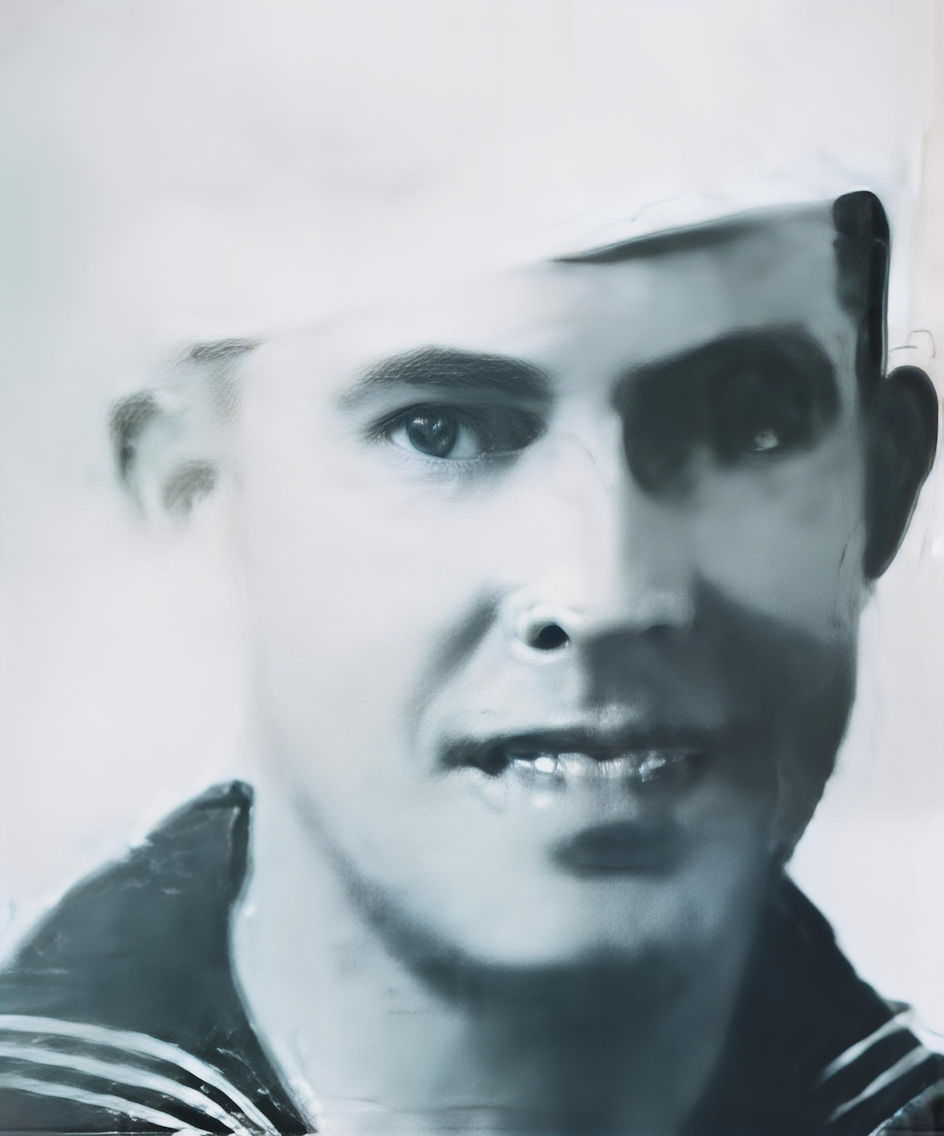
On the 70th anniversary of the sinking, the Dallas Morning News published an article after noting that the Cantrell family had submitted a "In Memoriam" notice for Billy that stated he was lost in the sinking of Indianapolis. It included the photo that is shown at the top right of this biography.
The news reporter, Steve Blow, visited Pamela Cantrell-Brown in her home in Mesquite, TX. The article stated, "Everybody else was so happy because their guys were coming home," Pamela said. "But Billy's parents were never the same after his death.
"It cast a pall over the whole family," said Pamela's brother, Bill Cantrell of Weatherford, who joined her in placing the "In Memoriam" notices in the newspaper.
They are too young to have known Billy. But they grew up hearing their late father talk often about his first cousin. "They were like brothers," Bill said. "As he got older, my father talked more and more about him. I think he really grieved for him."
Billy grew up on the southern edge of downtown Dallas, where his parents owned a succession of rooming houses. Billy rode his bicycle all over downtown and beyond as a messenger for Western Union.
He hadn't been on the Indianapolis long when it went down in just 12 minutes, carrying 300 men with it. "Family lore was that someone saw Billy in the water, but we never knew for sure," cousin Bill said.
Elders in the family remember talking to a survivor of the sinking from the North Texas area who remembered seeing Billy in the water.
Source Credits*Note: On Jan 1944, the rating of F3c was eliminated by the Navy. The normal progression became AS to F2c. F2c was moved from 5th to the 6th pay grade.
Grayson County Clerk's Office; Sherman, Texas; Grayson County Marriage Records; Ancestry.com. No page or number shown. Citing marriage of J. W. Cantrell and Ruby "McLean."
TX State Board of Health, Bureau of Vital Statistics, Standard Certificate of Birth, Register No. 88, #50383; citing birth of Baby Cantrell, Aug 26, 1926, to Julius Cantrell and Ruby "McClean" Cantrell.
1940 US Census, TX, Dallas Co., Dallas, Prect. #1. Enumerated 22 April 1940. HH #252; citing family of Julius W. Cantrell.
Faram, Mark D., Chief of Naval Personnel Public Affairs (2021). "Midway, Momentum, and Manpower- The Navy's Bureau of Personnel in WWII." Online at navy.mil.
USN WWII Muster Rolls, 1938-1949; Ancestry database
USN Ships, Stations and Other Naval Activities, 1939-1949; Ancestry database
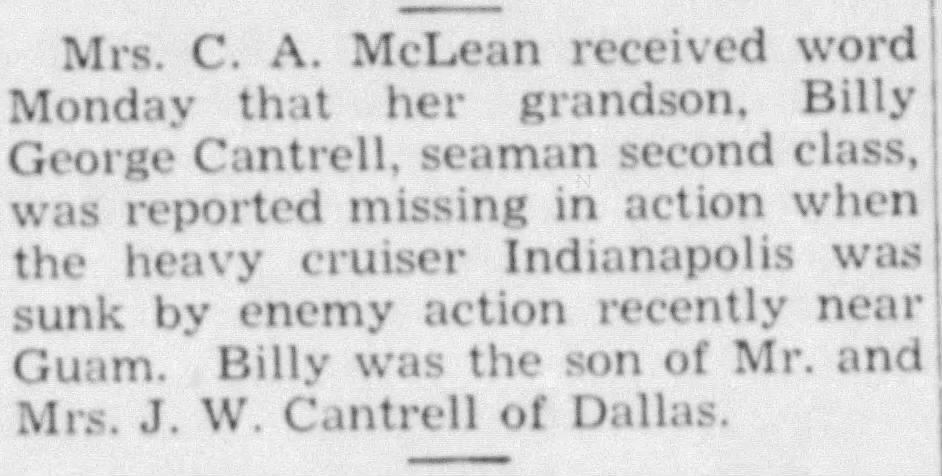
The Whitewright Sun (Whitewright, TX), Thur, Aug 16, 1945, p. 1; citing Billy George Cantrell MIA.
Primary photo: Dallas Morning News, published from Jul. 26 to Jul. 30, 2015; "Billy Cantrell Memoriam." Submitted by "Pamela and Bill and the entire Cantrell family." Online:
https://obits.dallasnews.com/us/obituaries/dallasmorningnews/name/billy-cantrell-obituary?id=37589660
Dallas Morning News, July 29, 2015, "Steve Blow: On anniversary of USS Indianapolis tragedy, a cousin remembers." Online:
https://www.dallasnews.com/news/2015/07/30/steve-blow-on-anniversary-of-uss-indianapolis-tragedy-a-cousin-remembers/
 Rank / Rating: F2-Fireman Second Class